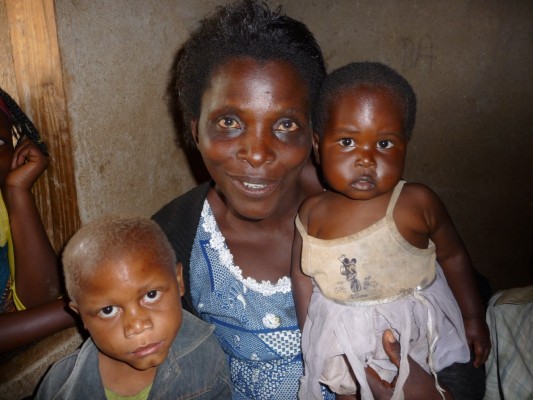
Mama Dorcas with orphans

Mama Dorcas is a remarkable woman. She was a trained nurse working at the Anglican hospital in Butembo. Being married but not having any children, she started to personally care for orphans in the 1990’s. With the coming of war, she soon was caring for far more children than she could manage. In 2003, she sought and received help from the Canadian based organization CSCODI. They were able to establish an orphanage that today houses 32 children with no electricity, no running water, only a wood stove and the smaller children sleeping on fabric spread over a mud floor. In addition, this orphanage supports and is responsible for 200 additional orphans that are being housed by local Christian families.

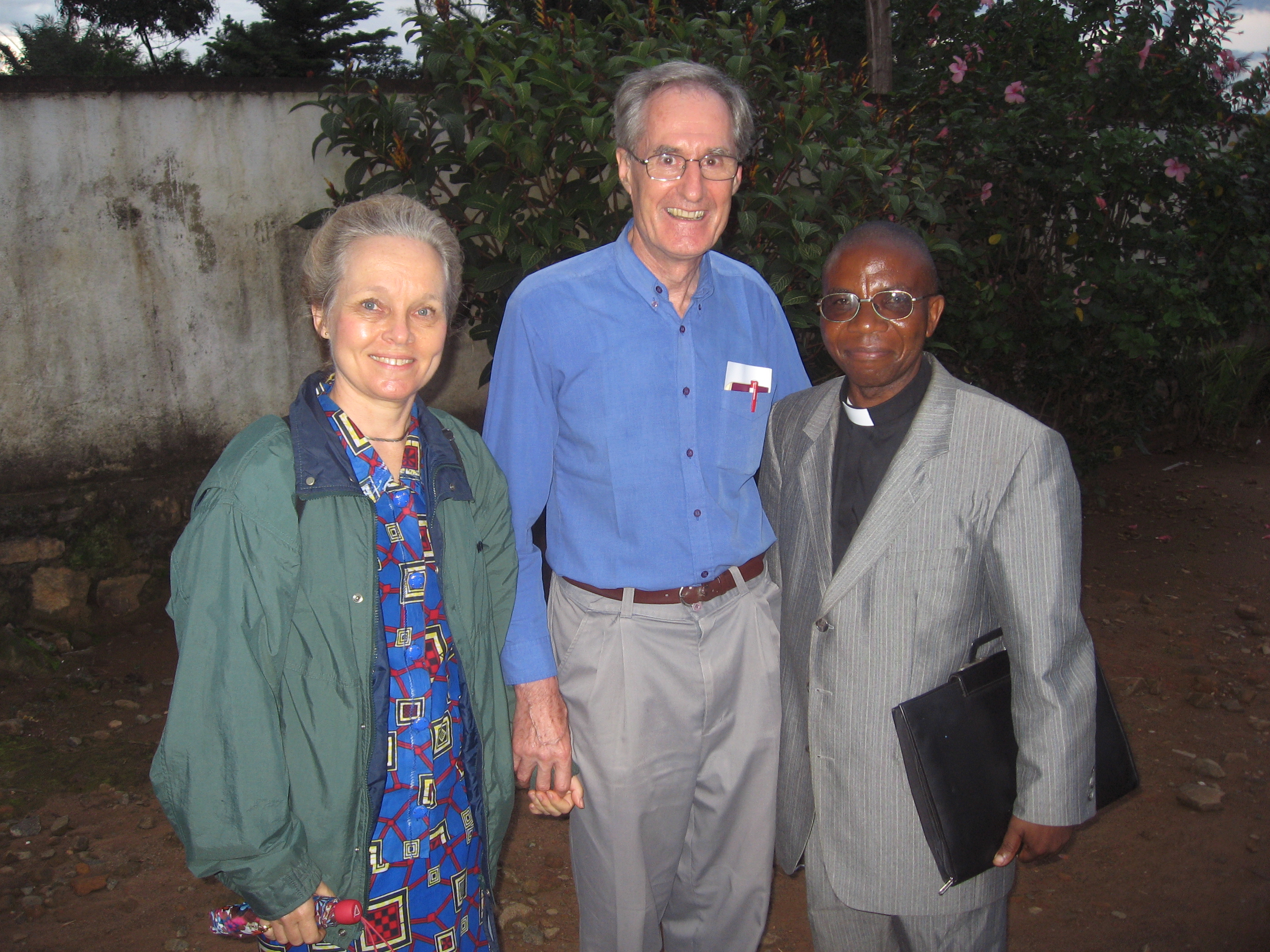
At the Butembo CSCODI orphanage during our 2008 visit

One of our personal goals is to meet Mama Dorcas, go to the market with our hired driver and purchase items such as cooking pots, mattresses, blankets or whatever items she feels are most needed.

Mama Dorcas runs this orphanage in Butembo, has helped to create a school and now also spends her time supporting a hospital in Beni focused on supporting mother and children plus raped women. Did I mention that Mama Dorcas is a remarkable woman?

James Kataliko was the first recipient from the Brenda Ben Bursary Fund through partnership with Healing Streams.

Healing Streams team members first met James in his capacity as CSCODI secretary and youth program director in 2008. We were impressed with his dedication to his work which is all-volunteer based. In an impoverished country, James was demonstrating leadership and a resourcefulness that we wanted to nurture. James had recently experienced a setback when his mentor, a pastor and CSCODI supporter died unexpectedly. Healing Streams was delighted to step into the gap and provide a bursary so James could continue to develop his leadership skills.

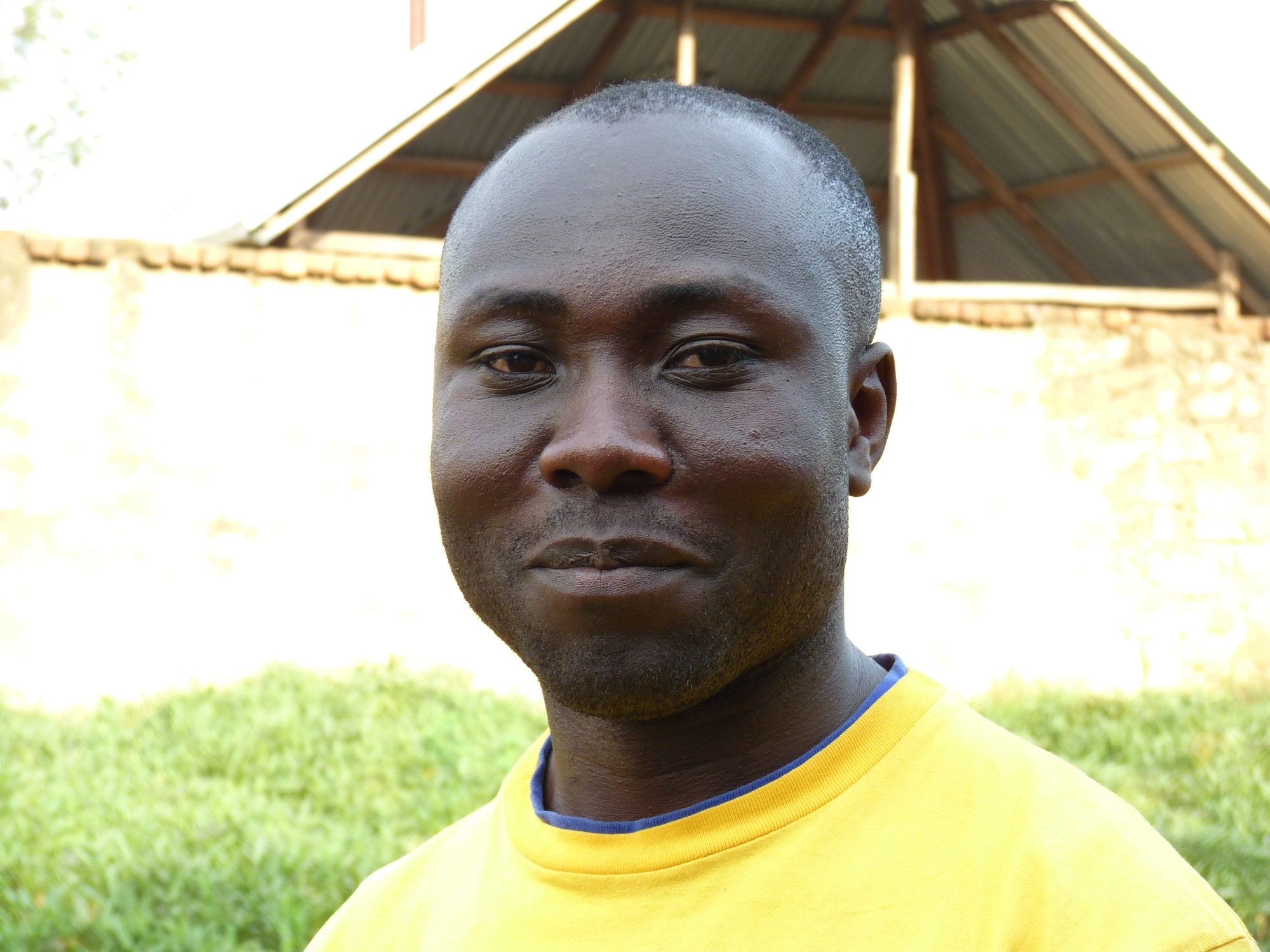
James Kataliko

He has completed his first degree (College level) in the Faculty of Public Health and Community and defended his thesis. He is now beginning a second degree (Bachelor level) with a topic of “The management of the treatment cycle of anti-retroviral drugs in the Elpis Zoe program (CBCA) in Butembo.” His dream is to be an administration or teach in the area of community health.

Currently he has developed 10 peace clubs for young people. These clubs are designed to teach young people how to resolve conflict without violence or war. He would like to further develop this project to counteract the influence of groups like the Mai-Mai who lure young people into their rebel groups with the promise of meat.

James will be our guide and translator during our time in Butembo, where we expect to visit an orphanage, a child soldier rehabilitation program and a microfinancing program.

When the Belgiums left Congo, there were nine Congolese in the entire country with a university degree. James will be a future leader for his country.

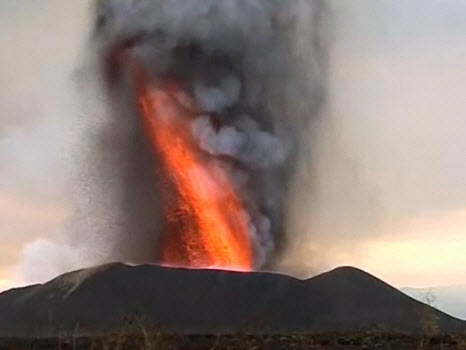
http://news.nationalgeographic.com/news/travelnews/2011/11/pictures/111116-volcano-virunga-tourists/#/02-nyamulagira-volcano-virunga-national-park_43703_600x450.jpg
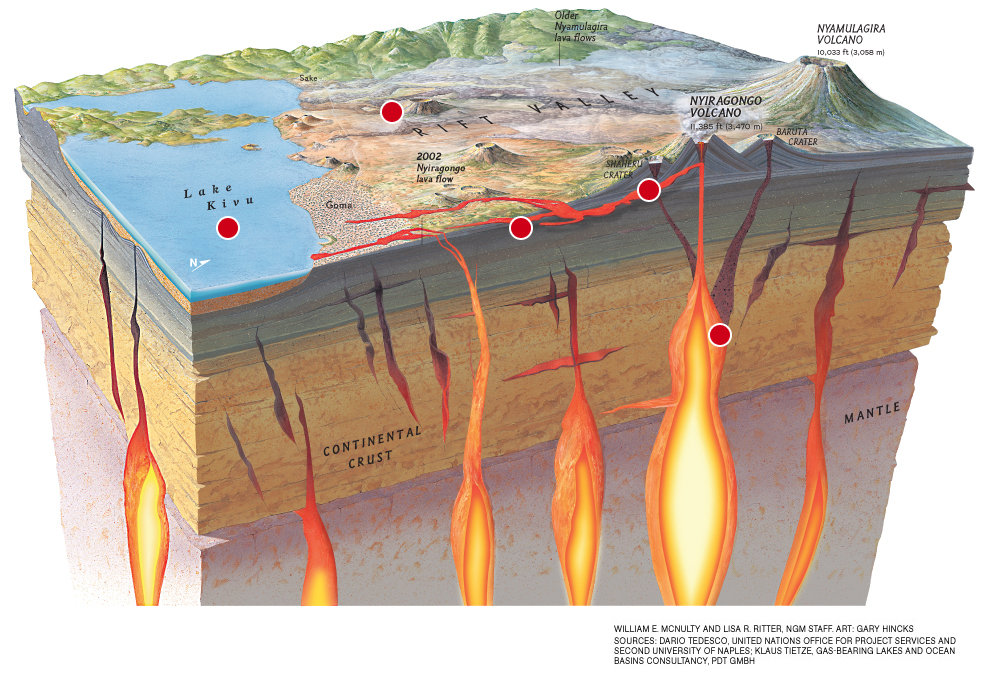
National Geographic photos of the active volcano near Goma

National Geographic Goma Interactive Map

http://ngm.nationalgeographic.com/2011/04/nyiragongo-volcano/volcano-interactive
The map is interactive at the link.
 

This volcano, Nyamuragira, is 8 km north of the Nyiragongo volcano, which is much closer to Goma. We’ll be missing this show with our recent re-routing away from Goma.

http://www.theweathernetwork.com/news/storm_watch_stories3&stormfile=experts_say_congo_volcano_er_141111?ref=ccbox_homepage_topstories

Experts say Congo volcano eruption huge, but safe

Africa’s most active volcano, Nyamuragira, is putting on quite a show for anyone who can get close enough to see it.

The volcano, in a remote area of the Democratic Republic of Congo’s Virunga National Park, and near to the town of Goma, is in the midst of its biggest eruption in a century.

The national park is a World Heritage Site renowned for its diversity both of flora and fauna, and while volcanologists and park officials say the eruption does not pose any immediate threat to the local population, they are keeping a close eye on it.

They say they have detected a dramatic increase in seismic activity and that the eruption has increased in intensity.

“It is perhaps the Nyamulagira’s biggest eruption this century,” said Tedesco Dario, a volcanologist with the Goma Volcanological Observatory.

“The fracture runs about one kilometre, which is huge, and its lava fountains are reaching almost 400 metres high,” he added.

Goma, a town of more than 500,000 people, lies on the Democratic Republic of Congo’s eastern border with Rwanda and is close to neighbouring Uganda, Burundi and Tanzania. In 2002, an eruption by Nyiragongo, a volcano much closer to the town, sent a stream of lava up to a kilometre wide and two metres deep through the centre of the city.

While Dario plays down fears, he does raise the possibility that seismic activity in the Rift Valley could spread to Nyiragongo.

Nyamuragira Volcano, north of Goma

“For the time being, the population of Goma and its surrounding areas should not worry. There is no current danger to the inhabitants, I would say the risk is nil. The problem with this eruption is that it was preceded by significant seismic activity, which means there have been a lot of tectonic earthquakes which were also felt around the Niragongo volcano. Our problem is in fact the Niragongo, it is not the Nyamulagira. We are worried that the Niragongo could be shaken by this seismic activity and earthquakes, and its southern front could open up. This front is very fragile, and could pour lava towards Goma town. For the moment, there is nothing that points towards this scenario, so we are somewhat happy,” he said.

Meanwhile, officials at the park are keen to make the most of the eruption, and say it is safe for tourists to visit the site.

“It has been assessed that it’s possible to get quite close to the volcano safely, and to spend the night here so things are looking quiet positive in that respect,” said park ranger, Emmanuel Demerode.

The Virunga National Park is home to one the world’s last remaining wild populations of mountain gorillas, and also has elephants, chimpanzees and hippopotamuses.

The second election in Congo’s history is still two weeks away, but violence and hate speech are already on the rise.

From the Christian Science Monitor:

The excitement and anticipation of the upcoming Congo elections have been overshadowed by rising tensions between opposing political parties, resulting in recent clashes throughout the country. The election – only the second in the nation’s history – is set for Nov. 28, but already violence and hate speech surrounding the election has heated up and fears of further eruption are looming.

Clashes between opposing parties have spread to the far corners of Congo. Over the past weeks political unrest and shootings have been reported in the nation’s capital Kinshasa. Last week, armed men in Kinshasa opened fire on opposition party supporters after they had reportedly finished distributing Union for Democracy and Social Progress, or UDPS, posters – seriously injuring two people. Earlier this week, on Nov. 7, political tensions kept many Kinshasa residents in their homes, as shop windows were smashed, banks shuttered, and pedestrians were mugged, according to Agence France-Presse.

Also on Nov. 7, on the other side of Congo in the eastern city of Goma, the capital of North Kivu province, there was reported unrest and shootings after a popular Hunde singer Fabrice, who was singing songs in favor of the opposition party, was abducted, and his fellow ethnic Hunde protested.

This trend of violence has become more of the norm than the exception. In the southeast city of Lubumbashi, political tensions spilled over into violence as early as August when Union of Nationalist Federalists of Congo, or UNAFEC, members attacked the office of UDPS presidential candidate Etienne Tshisekedi. And more recently in Lubumbashi, clashes between opposition parties left more than a dozen people injured this week.

Congo’s widespread electoral violence has garnered the attention and concerns of both the African Union and United Nations mission in Congo. This week, AU chairman Jean Ping visited Kinshasa to call for peace leading up to the elections, and the UN issued a new report detailing numerous human rights violations during the pre-electoral period.

“The kind of intimidation, threats, incitement, arbitrary arrests and violence that we have documented is unacceptable, ” said Navi Pillay, the UN human rights chief. “The government and leaders of political parties must make it clear that there is to be zero tolerance against any such actions which seriously limit the exercise of the right to vote.”

The UN report noted an increase in political activities and acts of violence targeting political party members, journalists, and human rights defenders. It also recognized “worrying trends of manipulation of the state’s police, intelligence and justice sectors by political actors,” and warned that the continued repression of human rights in the pre-election period may increase the likelihood of post-electoral violence.

The Congo is no stranger to this. After the 2006 vote, several armed clashes took place between Kabila’s forces and former rebel Jean-Pierre Bemba supporters. The dynamic has changed this time around, and analysts predict that the main threat of post-electoral violence will likely stem from street protests, according to Reuters.

To avoid further explosions of violence, the UN called on the Congolese government to promote and respect human rights and hold all perpetrators of electoral violence accountable, and on political parties to issue public statements promoting peaceful participation in the voting process. Although these steps sound respectable on paper, it is whether or not they are implemented in practice that will determine the fate of the 2011 Congolese elections.

The better part of valor is discretion.  Sir John Falstaff. Henry IV, Part 1

With some sense of disappointment, we have altered our plans to avoid Goma and to instead enter Congo via Entebbe and Bunia.

I was looking forward to Goma, even if it has been granted the title of the World’s Most Dangerous City by several sources.  This title was granted due to three pressing reasons, which we felt were manageable risks.  Scheduling our trip through Goma, however, crossed the line with the introduction of a fourth reason.

The traditional three reasons:

  1. Goma has been under threat as part of the ongoing Congo war zone, although the direct risk of bullets flying has largely subsided.
  2. Goma is situated immediately beside an active and threatening volcano, Nyiragongo, http://ngm.nationalgeographic.com/2011/04/nyiragongo-volcano/finkel-text which destroyed much of the city in 1997: 
  3. Goma is sitting on a massive carbon dioxide bubble which threatens to suffocate everyone.

Reason #3 is quite fascinating.  Goma is beside Lake Kivu, which apparently is sitting over an area saturated with carbon dioxide and methane.  If there was an earthquake, volcanic eruption (see risk #2), or some sort of seismic shift, it could cause the release of a mammoth bubble of heavier than air gas.  Unless the winds were very strong that day, the possible cloud of CO2 could suffocate everyone in the lower elevations.  CO2 suffocation frequently happens in association with volcanic emissions around the world.

On August 21 1986, at Lake Nyos, in Cameron, Africa, a massive cloud of carbon dioxide was belched after an eruption that killed around 1,700 people and 3,500 livestock nearby and injured thousands more. It’s estimated that 1.6 million tonnes of CO2 was released in the event and as CO2 is denser than air, hugged the ground in a layer thought to be 30 metres deep for quite some time and distance before it dissipated, suffocating humans and animals in its path. The outgassing also caused large waves that destroyed trees and other vegetation close to the lake.  The Lake Kivu gas concentration is believed to be much larger, although it would likely not travel down a slope as at Lake Nyos.

Now we have a reason #4.  We expected eastern Congo to be relatively violence free during the election period.  However, with a major opposition candidate being from the east, there have been several reports of clashes between supporters in Goma.  There appears to be roving mobs of supporters and being in their path would not be a good thing.  There is also a reported risk that flights could be grounded on the day we planned to fly out of Goma, leaving us with the possibility of an extra five days in Goma.  The bottom line is that it is not an ideal time to visit Goma.

Fortunately, rerouting through Entebbe has worked out very well.  The added cost of flying to Entebbe by Air Uganda is essentially equal to what we saved by going to Kigali in the first place.  This new schedule allows us to start our work at the hospital a day earlier than originally planned, but we will arrive well rested after having an extra day in Kigali to shake off any jet lag.

The Congo election scheduled for Monday November 28 is going to be a big part of our trip, so here is a primer for you.

Background
The CIA installed dictator Mobutu Sese Seko was deposed in 1997 after decades of pillaging the country.  The related war and strife racked the entire country.  It has been described as the African equivalent to World War II as all neighbouring countries at some point attacked in pursuit of their own interests.  An estimated 4+ million people died, in large measure due to resulting famine and malnourishment.  The 1994 Rwandan genocide perpetrators slipped into eastern Congo as the victorious Rwandan minority Tutsi’s pushed the majority militant Hutu’s into Congo via Bukavu and Goma.  In 2001, Joseph Kabila succeeded his despotic father, Laurent Desire Kabila, although localized fighting continued for a few more years.  The Hutu’s kept the turmoil going while the ineffective UN peacekeepers, by far the world’s largest peacekeeping mission with zero Canadian involvement,  mainly just watched.

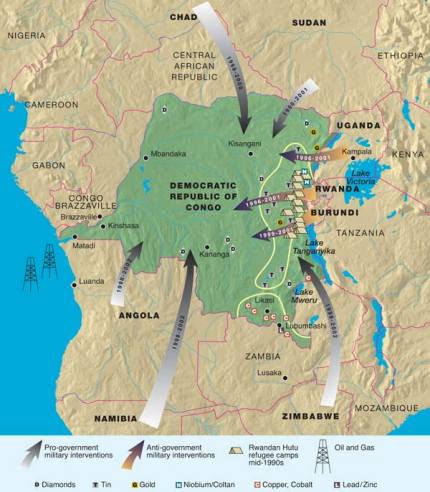
Much of the violence was prolonged by the mineral wealth of Congo.  Invading countries feverishly stripped out what mineral wealth they could.

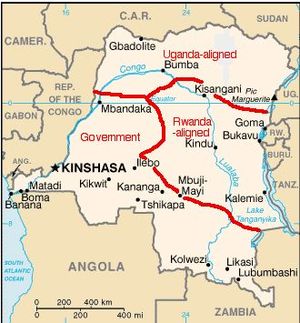
Neighbours Invading Congo

Foreign control of DRC in 2003

In the vacuum after the withdrawal of foreign armies, rebel militia sought to control mines for extortion purposes, using rape as a weapon to control the local population.  Child soldiers were commonly trapped through threats and the provision of drugs.  While Blood Diamonds was filmed in Sierra Leone (west Africa), it could have been set in Congo.
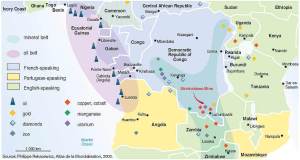
Congo Mineral Wealth

The first election in 2006 saw Joseph Kabila elected in a run off election against Jean Pierre Bemba.  Turn out was an amazing 70%.  Violence erupted in the west, the support base of Bemba, with the announcement of Kabila’s victory but then cooled off.   Although Kabila is the son of the former Congo dictator Laurent Desire Kabila, Joseph is western trained, western friendly and for the most part has attempted to act democratically.   Continuing violence in the east has been caused in large measure by Rwandan Tutsis who crossed into Congo in efforts to seek revenge on Hutus, plus unrelated troubles caused by the Lord’s Resistance Army and Mai Mai militants.  These forces have now been largely, but not completely, neutralized.  Obama has recently ordered 100 U.S. marines into the area to hunt and destroy the LRA as the UN has proven its ineffectiveness to contain them.

Current Elections
Joseph Kabila is honouring the need for elections and has repeatedly said that he will peacefully step down if re-elected.  He changed the rules to have one election for president with the candidate securing the most votes winning.  In 2006, there were two election days, with a run off votes between the top two candidates.  The change to one election is clearly in his favour as there is no obvious strong alternate candidate.

There are also legislative elections that are receiving virtually no attention.  Congo has a bicameral Parliament with 112 Senator seats and 500 National Assembly seats.  With most of the legislative seats awarded through an open list proportional representation system which results in party insiders gaining seats in Parliament but having reduced local accountability to voters.  This is likely a contributor to the sense in eastern Congo that government is no way to be seen, except by a machine gun here and there.  You can correctly infer my views on our first past the post political system.

You can imagine the logistical nightmares of campaigning and voting in a country without roads.   The opportunity for fraudulent voting is immense.  There continues to be concerns about ballots being distributed into the interior by November 28.  The plan is to have everything counted, scrutinized and reported by December 6 which is Kabila’s last day to legally serve as President.  I remain skeptical that they can pull it off on this schedule, but it appears that all systems are go.

Candidates
It’s not an impressive opposition, but running and losing in a place like Congo can be life threatening, so it should not be a surprise.  As you review this list, you can see why people expect Kabila to be re-elected.

Jean Pierre Bemba remains arrested and under trial by the International Criminal Court in the Hague for two crimes against humanity (mass murder and rape) and three counts of war crime.

Etienne Tshisekedi has been the foremost opposition leader for years, but recently has said some stupid things.  In a radio broadcast, he proclaimed himself president because “he represented the majority” and ordered his followers to stage jailbreaks to free detained colleagues.   This has been met with universal condemnation, so it is hard to see how he can get elected, but his call for violence is worrisome to many.

Vital Kamerhe served under Mobutu and is accused of being a Mobutu supporter in his youth. He later joined the opposition and then served under President Joseph Kabila before setting up his own party last year.   He is from Bukavu with ties to Goma, so his supporters would likely be the main reason for any clashes with Kabila supporters in the east.  With his support from the same geographic area as Kabila and no run off election he is unlikely to gain more support than Kabila.

Kengo wa Dondo is the current president of the senate. He served as prime minister under Mobutu, resigning shortly before the Mobutu government fell.

Francois Joseph Mobutu Nzanga is the son of Mobutu and thus has no hope.

Current Turmoil
Tshisekedi has called for violence on Monday November 14, so we’ll see what happens.  There have been many situations of various supporters clashing with each other in the streets, including Goma.  Overall, however, it is less chaotic than 2006.  There have been rumours of airlines being grounded from November 27 to 29 though, which would mess up our travel plans.

Reminders
Click on any picture to enlarge.  The best way to stay in touch is to Follow This Blog by E-mail, so any updates comes to you automatically.  We love to get comments as well as any questions or suggestions!

Our trip has been rescheduled for departure on Thursday November 24, returning December 13. Essentially, it is a mirror image of our original plans, with one extra day added.

A complication for our return could be the Congolese elections which are scheduled for November 28.  In the past, there has been violence around the elections and the borders have been closed, so we needed clearance from those in Africa before concluding it was safe to go.  Fortunately, the current president Kabila is expected to be re-elected.

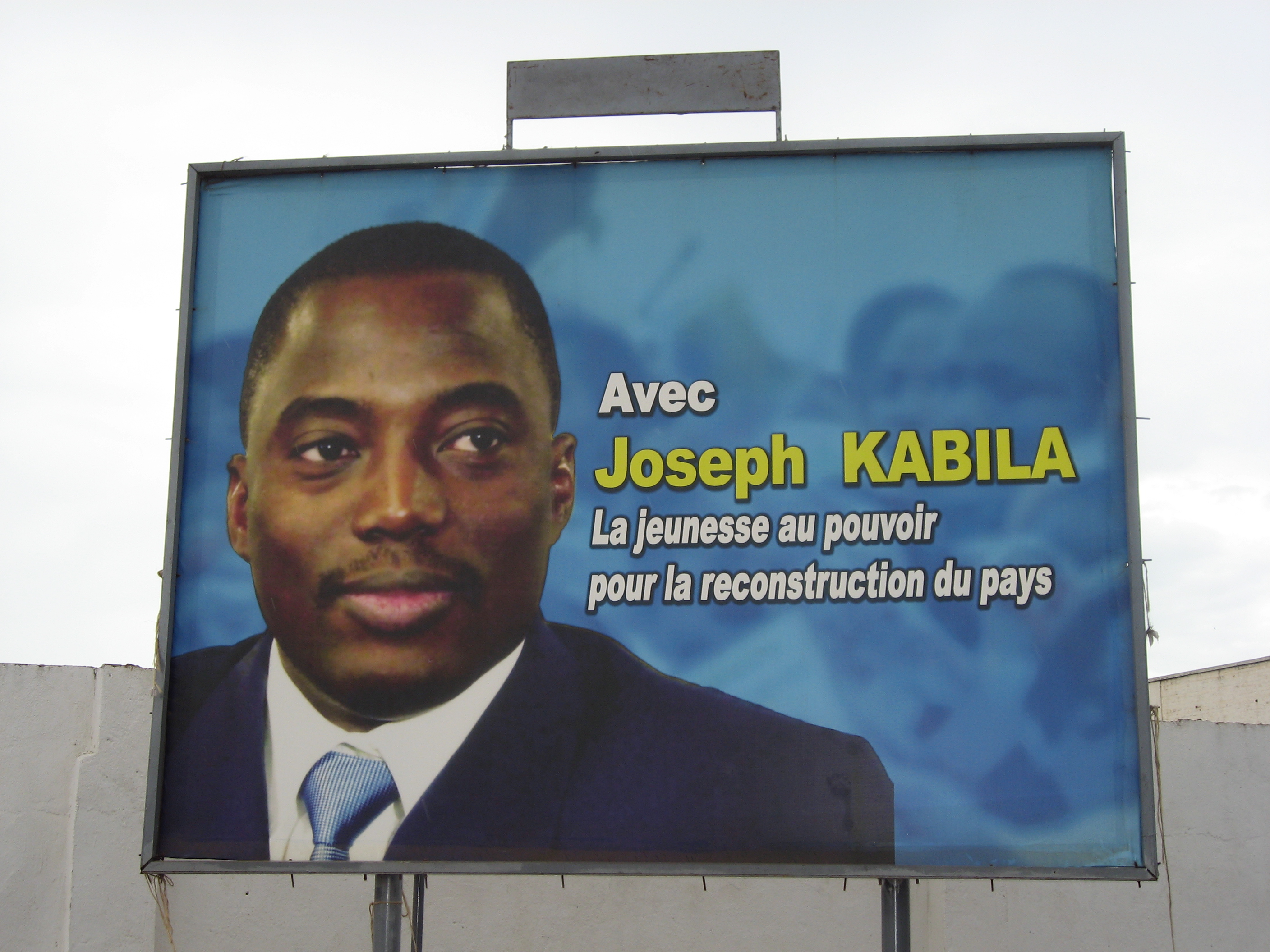
Kabila Campaign Sign 2006

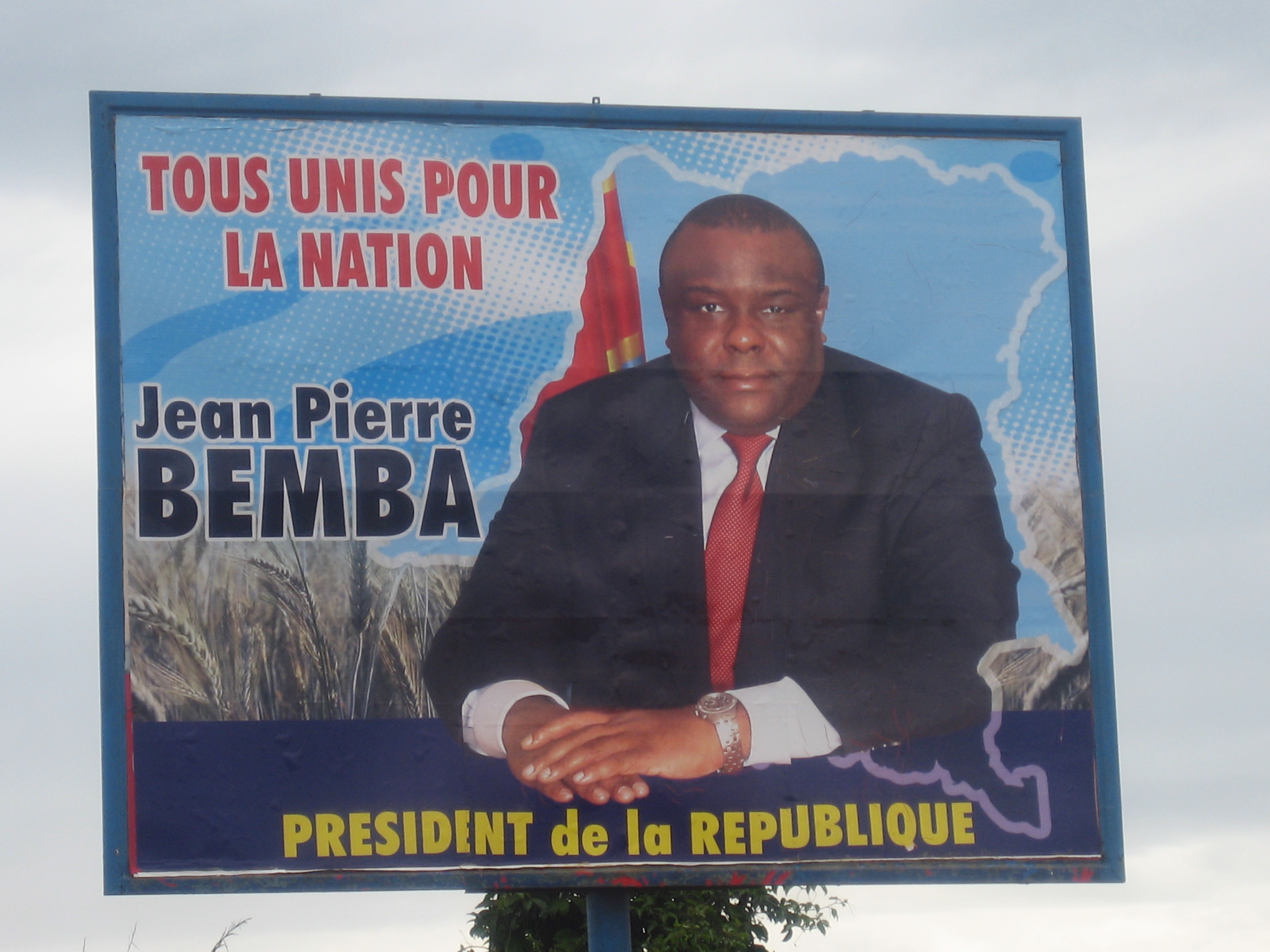
Bemba Campaign Sign 2006

Kabila is from the east, so any dissatisfaction with his victory will result in violence in the west (where during the last general election in 2006 the Supreme Court in Kinshasa was set on fire).

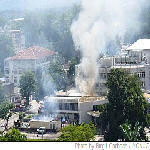
Congo Supreme Court Burning 2006

Congo Election Results 2006

Our risk is to have Kabila lose, but compared to previous dictatorial governments, he has been a relative saint.  Heavy on the relative, but this is Africa.

Further, the problems will arise not on the election day, but on the results day.  Imagine the logistical issues in a country like Congo.  It will take a minimum week and likely much more to determine and announce the results.  We will likely have already left the country, but we were in Congo in 2006 on results day (surrounded by South African peacekeepers).

South African MONUC (UN) peacekeepers

The decision involved knowing that if we didn’t go now (some work constraints prevented us from going sooner), then we couldn’t go for months.  To adjust for the risk of not getting a flight out of Goma to Beni (there are only flights on Monday and Tuesday each week), we advanced our trip a day so we have a chance to board two flights, not just one.  We cleared our decision with Nancy Wood of CME after she discussed the situation with multiple people in multiple cities on our behalf.

It was the weirdest feeling to drive back home from the airport and know that for two weeks you have absolutely no commitments.  That’s very different from nothing to do!  But we were kid free and faced with a clean slate of no meetings to attend, no deadlines to meet, almost total flexibility to decide our priorities.  It’s a cleansing process!

We’ve been asked about the rescheduling costs.  The trend started when we returned to the Direct Flight parking lot at Pearson where the manager waived our parking fee.  The only hotel that required a 50% deposit waived their right to the deposit.  Canada Post waived the additional mail hold fee.  Our only cost is with KLM where the flight differential with KLM was a whole $2 (foreign exchange change?), but there were rebooking fees of $250 per ticket.  More will be said about KLM later.  Brenda is crawling out of her skin to talk about their customer service and lack thereof.

On Saturday, we were presented with quite a co-incidence.  Brenda received a call from her aunt in Stony Creek, asking if we knew a Katembo Kaluma who was speaking at their church this weekend.  Of course we knew him!  He was our original connection for our trips to Congo. Kaluma (he goes by his “last” name) and his amazing wife Kaswera founded the charity CSCODI which run the orphanage and school in Butembo we visit.

CSCODI Butembo Students

Living in Quebec to earn his Masters and later his Ph.D., Kaluma and Kaswera were unable to return to Congo with the outbreak of war.  He has made amazing sacrifices and advanced CSCODI to now include microfinancing for women.

Also speaking in Stoney Creek on Sunday was Rosemary Walker who has served in Africa with AIM for many years.  She sends a big Jambo! to the Woods and others at CME.

Kaswera, Kaluma and Rosemary Walker of AIM

Meeting with Kaluma on Sunday enabled us to gain many valuable contacts in Goma, Beni and Bunia.  These connections will likely both increase our effectiveness as well as our personal safety.  We also learned that Kaluma intends to serve with African Inland Missions in the role of Program Officer for Relief and Development for 22 countries.  http://www.aimint.org/can/en/give/relief-and-development.html.  Unfortunately, it is a role that he must self finance through contributions.  If you can manage $10 per month or more in support of Kaluma, please let me know and I will connect you with him.  Imagine trying to raise funds when you don’t have family or many friends while living in Quebec with relatively weak Protestant churches.  It must be tough, so please support him if you can.

I screwed up. We are postponed, likely for one month.

Rwanda implemented a new visa requirement for tourists which I missed. Quite bizarrely, no visas are required for business purposes, but KLM wouldn’t let us board. I was able to contact a Rwandan official in Ottawa and we rushed an online visa app, but we needed a document back from Kigali to present to KLM, fighting tight time constraints and the time difference to Rwanda where it was 10:30 PM.

Other short term options (eg British Airways to Entebbe which doesn’t require a visa) aren’t financially pretty and were non starters
.
Quickly looking at our mutual work commitments, we have come up with a plan. Tentatively, we rebooked on KLM for November 25, returning December 13. This is a replica of our current schedule bumped by four weeks. Thankfully, the added cost charged by KLM is nominal. Before we commit, we will need to confirm with Brenda’s ultra nice boss, my ultra understanding clients, the Woods in Congo and the domestic Congo airlines so we don’t get stranded in Congo with no way to get out.

Was this just a simple screw up or, for those more deterministic, a blessing for some currently unknown reason? All I know for sure is that I am grateful to have a wonderful wife who is not all over me for such a major screw up.

Weather at a Glance – Goma, North-Kivu, DRC
Elevation 1552 m

Sunrise / Set
4:41 AM
4:51 PM

Now
Light Rain Temperature 17 °C

Tonight
Chance of Rain 13 °C

Friday
19 °C Chance of T-storms

Friday Night
14 °C T-storms

Saturday
Chance of a Thunderstorm 20 | 14 °C

Sunday
Chance of a Thunderstorm 20 | 12 °C

Monday
Chance of a Thunderstorm 21 | 11 °C

Enter your email address to follow this blog and receive notifications of new posts by email.

Join 66 other subscribers

Archives

Prior Posts