I must first thank my wonderful wife for allowing me to indulge my desire to play a round of golf at East Africa’s oldest and longest golf course at 6,684 yards. Built in 1932 by the British, it is adjacent to the Uganda Wildlife Education Centre, commonly known as the Zoo. It was my first experience with a caddy and being spoiled with carried clubs, washed balls, cleaned clubs and needed advice. We were joined by a Ugandan golf pro and national team member, Odong Steven. You don’t need to guess who won. Brenda walked the front nine, taking wildlife pictures, yakking with others on the course and then relaxed in the club house for the back nine.

I really should let others score for me more often. It did wonders for my reported scoring.  My caddy would graciously score me a bogey even when I lost two balls in the rough.

Teeing off in Entebbe

Teeing off in Entebbe

Driving at Entebbe Golf Course

Driving at Entebbe Golf Course

Monkeys in the Zoo next to the Entebbe Golf Course

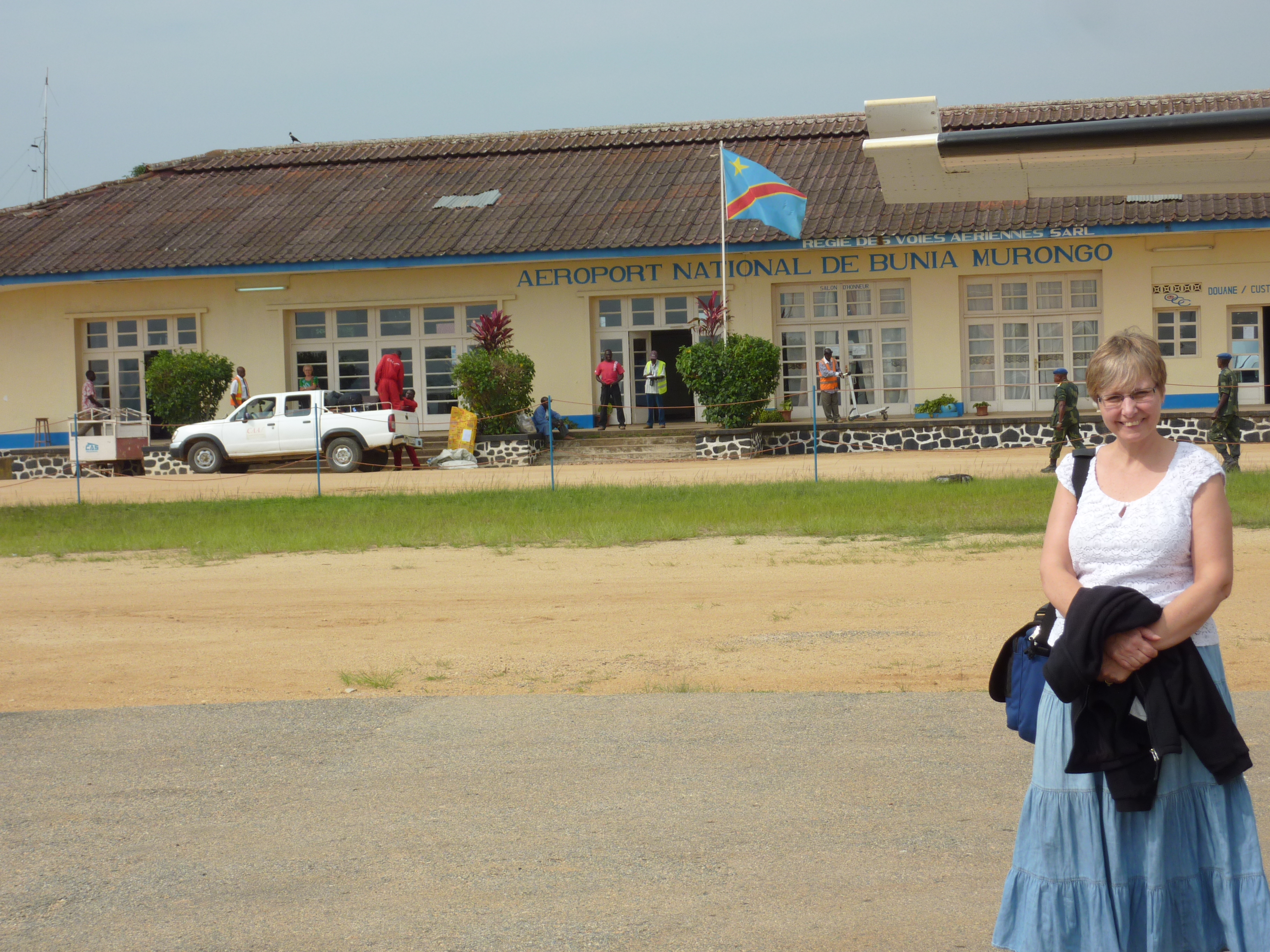
We leave tomorrow (Wednesday) for Bunia. We haven’t heard any reason not to go. The election day was extended over another day to permit everyone to vote, which we consider a good thing as it will likely delay the scheduled results announcement day. We are hoping for a postponement of two days, ideally a week,  so we can leave before results are announced.

Each ballot is 9 pages long, so counting and then any verification must be a nightmare! Some reports of concerns over stuffed ballot boxes seem exaggerated because the ballot itself is so big! I haven’t heard of any reports of inadequate ballot boxes inhibiting the voting, although that wouldn’t surprise me.

Kabila will win, and there will be disgruntled losers. I read a report of eastern Congo voters being disenchanted with Kabila so they won’t vote for him as they did in 2006. The story smacked of journalistic laziness, because the voter being interviewed was obviously English speaking and sophisticated, not your typical voter but someone easy to interview and obviously unrepresentative. The tribal reasons for voting for your tribal candidate remain unchanged, and with the high voter turnout in Congo, tribal reasons will explain Kabila will get elected.

There hasn’t been news of any abnormal violence in the east and the UN is also reporting a lack of violence in the east. While there obviously are issues and possibles threats in Congo, I am detecting some journalistic sensationalism too. In 2003, in Canada I talked with a Brit who had their trip to Edmonton cancelled due to SARS in Toronto. A travel ban was never placed on Vancouver or Toronto after Stanley Cup or G20 riots. Kinshassa and even Goma is a world away from Bunia, Beni and Butembo.

Our access to free Wifi Internet has been great so far.  But please don’t expect pictures or daily posting going forward as we expect our Internet access while in Congo will be very limited.

Pastor Matumo with wife Josephine

Pastor Matumo with wife Josephine and translator Masika

We were privileged today to drive into Kampala to visit Pastor Kahindo Matumo and his wife Josephine who has been quite ill. We first met Pastor Matumo in 2008 as he played an instrumental part in organizing the 2008 Healing Streams seminar in Butembo, Congo. Josephine was sent to Kampala as doctors in Butembo were unable to properly deal with her situation.  Pastor Matumo is the brother to Kaswera Katembo of CSCODI, the Quebec based charity which is responsible for the original involvement in Congo of Healing Streams. He is fortunately able to stay at a friend’s home in Kampala while his wife recovers.

Meeting Pastor Matumo in Kampala

Meeting Pastor Matumo in Kampala

Pastor Matumo is responsible for a large rural district near Butembo with the Baptist church.  He told me in 2008 how city pastors would typically receive an income of $20 per month, but rural pastors typically received $5 per month.  They survive on food and in-kind support from their impoverished congregation.

Early reports suggest that there will be trouble at various polling stations due to inadequate administrative preparations. It is a foreign concept in Africa to have to meet a deadline.

For some context, Elections Canada mobilizes 190,000 people to facilitate a Canadian general election. Canada has roughly half the population (35 million vs 70 million), a lower voter turnout (61% vs 80%), immensely superior techncial abilities and lengthy experience running elections compared to Congo. Congo simply doesn’t have the resources, training and experience to conduct a general election to Western standards without hiccups. Most importantly, a democratic acceptance of peacefully losing has not yet been ingrained into the culture.

The two main candidates on the weekend incredibly scheduled major campaign rallies in Kinshassa a few kilometers from each other. Police forced the cancellation of the rallies for fear of violence, but it led to police shooting rioters upset with the cancellations.

The real trouble will start when groups feel they have been unfairly disenfranchised, or they are simply ticked off, which will be exaggerated by the inadequate administrative preparations. This will be more fully expressed when results are announced next week.

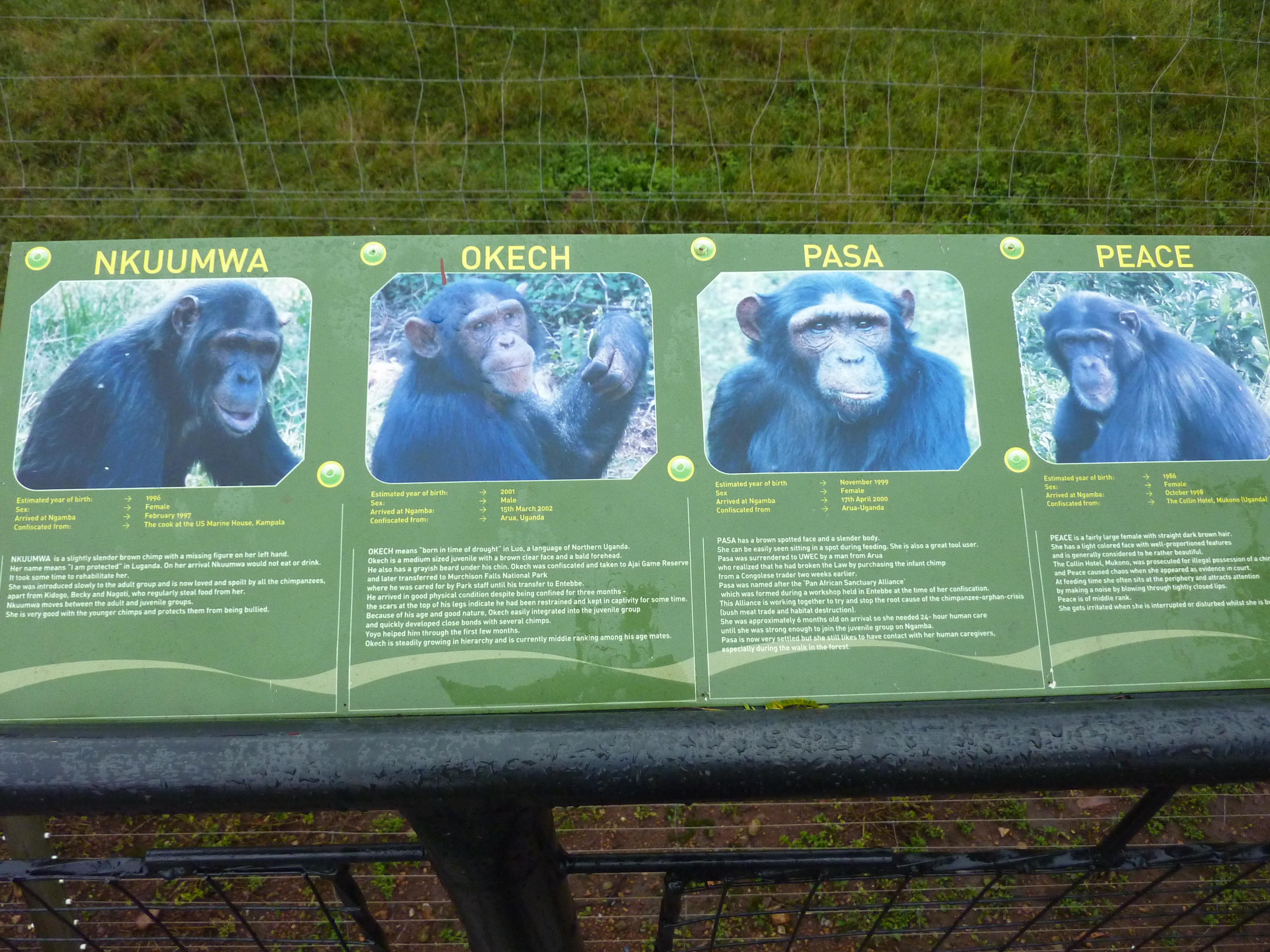
Ngamba Island is in Lake Victoria, 23 km or a 45 minute boat ride from Entebbe. It was established in 1998 to care for orphaned chimpanzees who were rescued by the Uganda Wildlife Authority. http://www.ngambaisland.com Supported by the Jane Goodall Institute and several other wildlife foundations, they gather rescued chimps, then nurse or return them to health in an effort to promote the endangered specie.

Chimp asking for more food

Chimpanzee asking for more food at the Ngamba Sanctuary

Most chimps spend the day are in the forest but they sleep in protected cages.  They have a feeding twice a day.  For our half day visit, we essentially came to watch a feeding.  Overnight stays involve personal interaction with the less aggressive chimps, who are all named and easily identified by staff.

Watch the video of the feeding time: http://youtu.be/G2vqGkWEgFc

Everyone Has A Name

Everyone Has A Name

We have settled into a Guesthouse in Entebbe after a smooth trip from Kigali to Entebbe. We are now 8 hours ahead of Ontario.

We had expected to fly into Congo tomorrow, but the border will be closed for the day due to the Congo election. We expect to go in on Wednesday. Otherwise, we stay in Entebbe until we can fly in. We have confirmed the option of a flight from Bunia down to Beni, but we are not yet sure of how we will get back to Bunia for a scheduled flight back to Entebbe. It’s one of those things we will just have to figure out.

Unfortunately, there are a lot of election problems being reported, but to date no violence (that we have heard of) in the cities we expect to visit. By far the worst violence, as expected, has been in the Kinshassa (west) area. From what I am hearing, this election has it’s issues, but far less than their first one in 2006.

We’ll now lose any sympathy there might have been concerning having to spend an extra two days in Entebbe with this next part. We might as well make good use of our time here! Tomorrow we are signed up for a day trip to Chimpanzee Island which is a 50 minute fast boat ride into Lake Victoria. It is a special reserve for chimpanzees run by Jane Goodall. We expect to feed and hold chimps who have been brought there for some humanitarian reason. On Tuesday, there is a good quality 6,800 yard golf course nearby where I’ve been told I can get rentals, green fees and a caddy for $30. Sign me up.

Entebbe was built by the British 60 km south of Kampala on Lake Victoria because it is has a very defensible position on a penisula into Lake Victoria. There were a lot of legacy benefits of being a former British colony in Africa compared to any other imperial power. A Parliamentary rule of law, a moral and strong civil servant culture, a supportive transition to independence, and now I can add good golf courses.

This may be random, but here are some things that struck me after a day of Genocide Tourism:

The current government really hates the French. The French were allied with the pre-genocide ruling Hutu party and aided the escape of the Interahamwe into Congo. The French have brought formal accusations against the Rwandan president that he ordered the rocket into the plane carrying the Rwandan and Burundi presidents which ignited the genocide (which he likely did). As a result, Rwandan kids now learn English in school instead of French and country is the committed to become English speaking. Neighbouring English speaking Uganda and Kenya, it’s probably the right move in any event for Rwanda.

The Genocide Memorial seemed surprisingly very critical of the Catholic church, claiming they promoted the concept of a superior (Hutu) race. That is totally inconsistent with any Catholic teaching I’ve ever heard, but I wonder if the French / Catholic association has something to do with it. I had always heard that the church tried to shelter victims, not encourage a genocide.

Romeo Dallaire is regarded as a Canadian hero in Canada, but there is no sense of that here. He is acknowledged as being in charge of the UN peacekeeping mission and having asked for more help from New York, but that’s about it. By association, he was the guy who failed to stop the genocide, while giving little acknowledgement of how desparately he tried to secure help. The Memorial was very critical of the UN and world leaders at the time, but did not cut Dallaire a break for trying to influence them. I think it is fair to say that Dallarie is little known as is his side of the story. I can see why he wanted to write Shake Hands With the Devil so his perspective can be documented.

The Genocide Memorial was very explicit: virtually nothing was done to deal with the impact of post traumatic stress disorders (PTSD) after one of the most traumatic events in human history. In Congo, the same can be said. That is why we believe in the efforts of Healing Streams which has been providing training to people on the ground in Congo to deal with people impacted by PTSD.

The Tutsi were a minority to start with but after 1,000,000 mainly Tutsi were slaughtered they obviously became an even smaller minority. It is easy to understand how the Tutsi general, Paul Kagame, became the leader of Rwanda after militarily defeating the Hutu’s in 1994. But coming from a minority, how can he be democratically elected by huge margins now? As a Canadian, I’ll suggest that he has provided peace, order and good government. Rwanda has been ruled by something close to a Kagame benevolent dictatorship for years, like Singapore, and it has worked. They are an economic miracle and crime is extremely low. He was the person who stopped the genocide. Why would people want to change what is working?

Kagame won the presidency with 78% of the vote and his party won seats with 98.7% of the vote. 98.7%! The reason is that he formed a coalition of parties which included Socialists, Muslims, you name it. If you want to share in government, come join me! If you want to eat my dust, then don’t join me!

This helps to complete the continuum of possible democratic political configurations: In Rwanda, all policy arguments are now conducted solely within the government. The extent of democracy can be debated as it depends on how the leader uses his power but the risk of a dictatorship is obvious. In the U.S. two party system, policy consensus is saught within each party with each party internally having a very wide range of policy opinions. A uniform party post-compromising is brought to the electorate. In Canada and other multi party systems, policy arguments are conducted within each party with opinions and divisions internally being far narrower in scope compared to U.S. parties. Each party tries to present a uniform party policy and consensus to the electorate, but on occasion minority governments force consensus to cross over to another party. (The U.S. system of checks and balances forces more co-operation than would otherwise be the case in a two party system.) In Canada, electoral success dictates the extent of cross party co-operation. Proportionatal representation systems force parties to be internally very focused and compels parties to work together to have any chance of a functional government. This is done at the cost of losing local accountability.

In structuring a political system, it’s not a matter of having political debate on issues, it’s where you have the debate.

Towards the end of our day, I asked our guide what tourists to Rwanda would do if they didn’t want to learn or see Genocide related things. The short answer is not much. Being was such an overwhelming event, that’s what you come and see in Kigali.

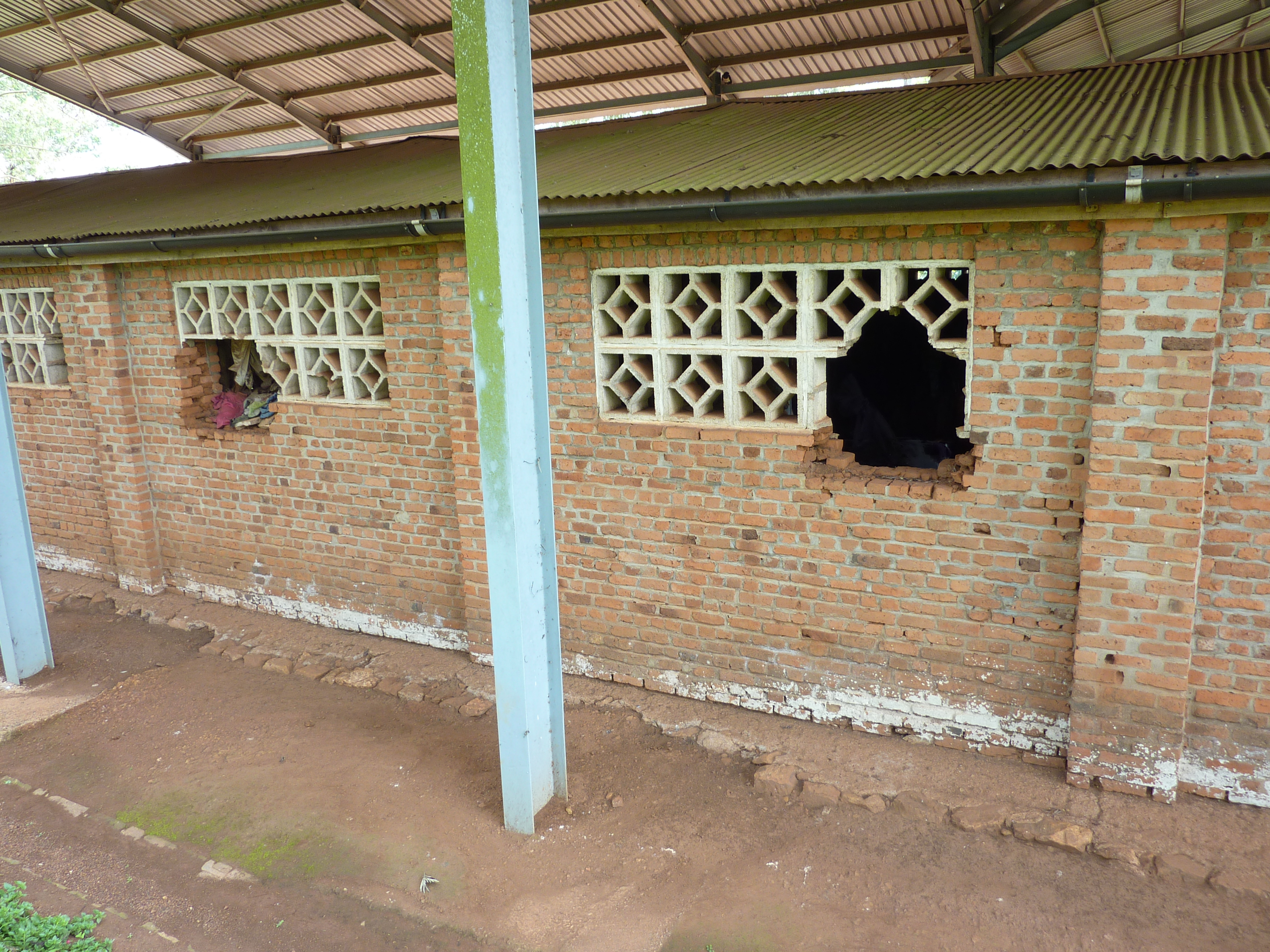
It was Umuganda today, so things don’t really get back to normal until 2:00 in the afternoon and our guide had to sweet talk our way into the two churches which were memorial sites of massacres, Nyamata and Ntarama. Piles and piles of skulls and other bones are piled row on row. Many skulls featured obviously machete wounds which gashed or completely severed many skulls. I found the worst part was the blood stained wall which babies and small children were thrown against. Nearby was a long pole used to kill babies in the womb. The depth of man’s potential inhumanity is truly staggering.

Ntarama Memorial Site

Ntarama Memorial Site

The holes in the walls and windows are from the murderers breaking into the crowded church where many hundreds were gathered for sanctuary.

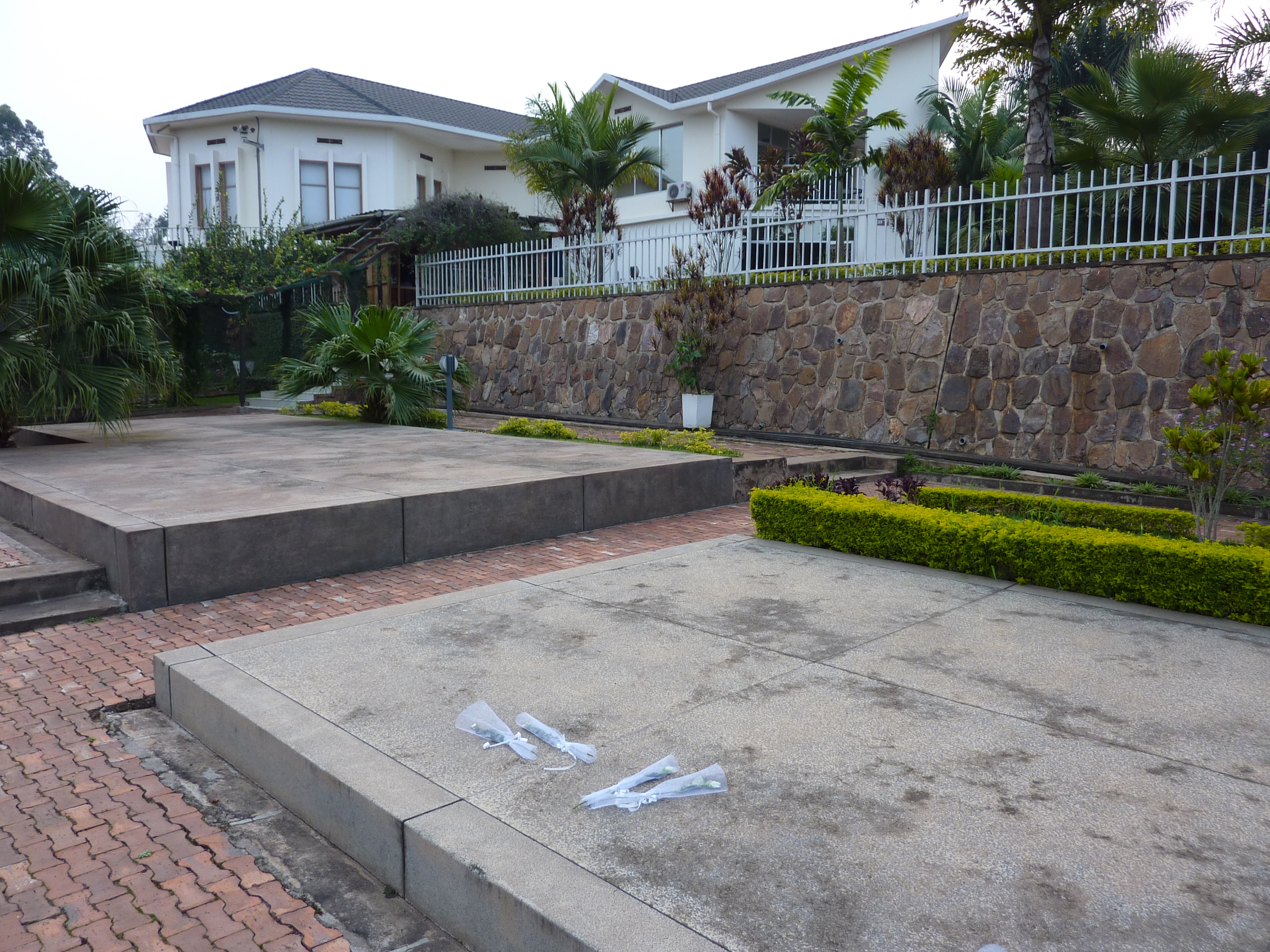
Can you imagine 267,000 people buried in one spot, here at the main Kigali Memorial Centre? There are many mass graves here which one photo can’t encompass. Words are not enough.

Kigali Memorial Centre Mass Graves

Kigali Memorial Centre Mass Graves

The Memorial has a section for other genocides of the last 200 years. From the Germans in East Africa, to the Turks in Armenia to Hitler to Pol Pot to the Balkans (and I missed some). I couldn’t help but think of how now we are watching Anti-Semitism grow right in front of our faces, while Israel becomes more and more isolated and Muslim hatred for Jews notably in the Middle East and Europe seems to deepen. Genocide doesn’t happen overnight. It is nurtured.

Sure we drove by a market, a president’s house and saw various other places with our hired driver. But after touring three genocide memorial sites, anything else becomes inconsequential. I hope I sleep OK tonight.

Umuganda meeting

Umuganda meeting

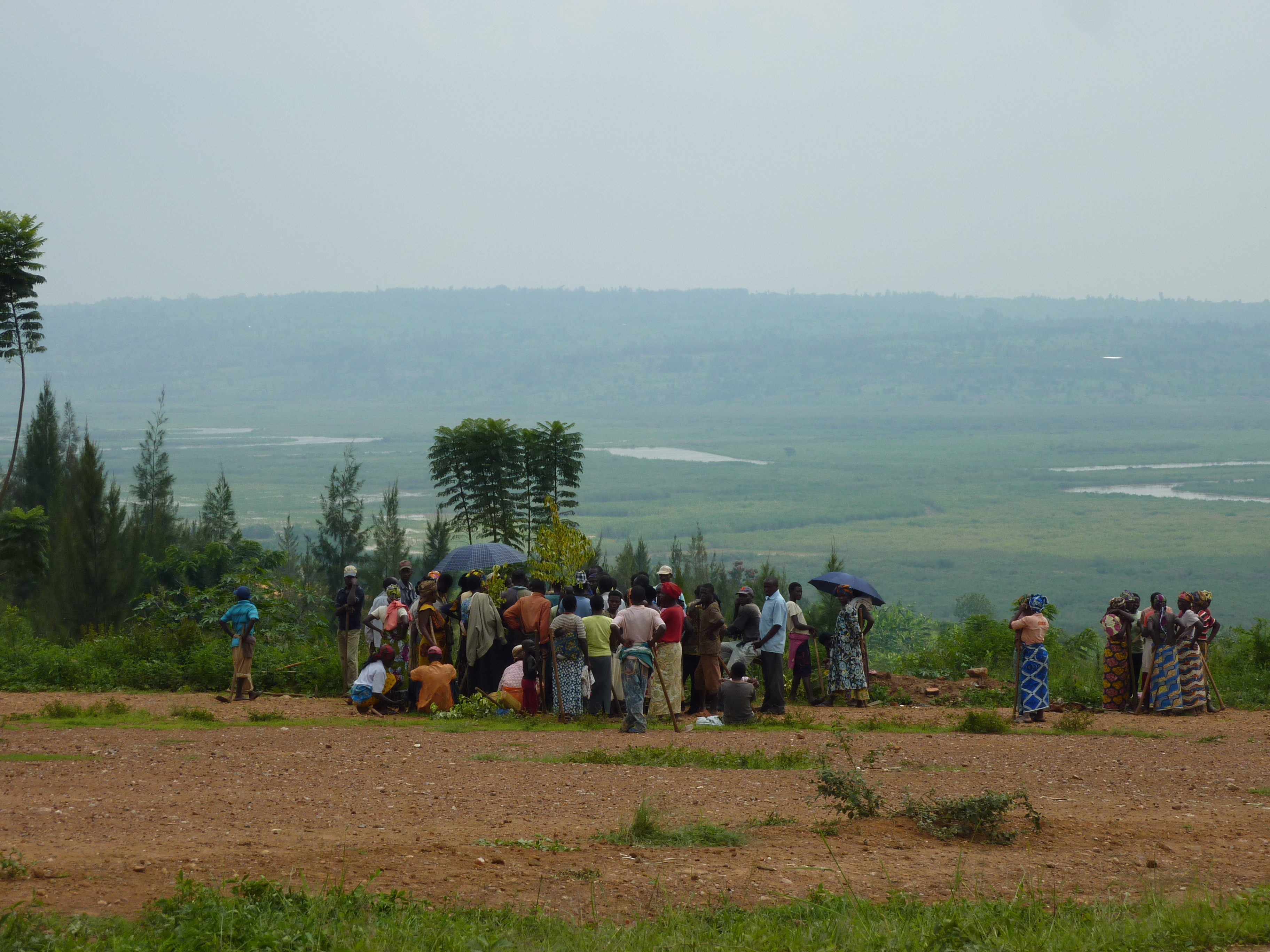
Umuganda, or “Contribution”, is a mandatory community work day across the country of Rwanda for adults 18 to 65. On the last Saturday of each month, everything is closed or shutdown to permit people to conduct an act of service in their local community. It could be cleaning the streets, improving a washed out road or who knows what. A chairperson is approved by the government to oversee, direct and report on what is done. While the government is ensuring that a satisfactory process is in place, all decisions are meant to be locally driven. At the end of each work session, a meeting is held where people discuss local issues and recommend what should be done the following month.

This is a relatively new phenomenon in Rwanda (I heard two years old), but it is consistent with an active (some would say interventionist) government. Plastic bags are totally banned. Littering is a serious offence. The net result is a very clean country, which only adds to its natural beauty.

It’s hard to gauge how popular Umuganda is, but it was apparent that it was real. We have a great view from a hill overlooking Kigali and in a wide expanse I could see a total of two cars moving where there are normally many hundreds. Our day didn’t start until 11:45 and we saw many huddles of people obviously in a town hall style discussion.

Umuganda meeting in the countryside

Umuganda meeting in the countryside

We were told that crime rates are very low now (consistent with a Chinese or Dubai style of enforcement). At 4:00 pm, the army comes out for their 4 pm to 4 am shift and can be seen everywhere. My sense is that the people are very willing to have a strong government imposing a strict code to ensure cleanliness and safety after the Genonicide of 1994. Umuganda fits into the culture well with the emphasis on working together as a community, instead of being divided by old tribal hatreds.

Our trip and arrival at our B&B in Kigali, Rwanda was as pleasant and uneventful as possible. I was reminded that one of the best sights when travelling to a foreign country is seeing someone at the airport holding up a sign with your name!

Our plan was to tour Kigali on Saturday by hiring a car and driver for the day. It turns out that tomorrow is Community Day, the fourth Saturday of the month, where people clean up the streets in the morning. Travel is severely restricted while streets are cleaned, so we won’t have a car and driver until the afternoon. We’ll learn more tomorrow but I’m anxious to learn how supportive or coerced the people feel about Community Day and say more later.

Our itinerary in Congo has already changed significantly. Joseph, the accountant we will heavily depend on, has asked that we work in Bunia, so our visit to Beni looks eliminated. We will stay with the Woods in Bunia which is a pleasant upside. We are not sure of flight schedules to and from Butembo with the election underway, so we will follow the African way and go with the flow.

The Woods are an epic example of self-sacrificing through their willingness to serve others in the name of Jesus Christ. Both are trained medical doctors and were married after graduating from their respective medical schools in Toronto and England. They have been serving as medical missionaries in Africa ever since.

Our first time meeting Philip and Nancy Wood in Beni, Nov 2006

They have been instrumental with the development and expansion of CME Nyankunde, the largest NGO health network in northeast Congo. Philip has been Executive Director and Head of Surgery while Nancy leads the large nursing school. They have fled for their lives at least twice. In 2002, Congolese rebels destroyed the flagship hospital, killing half the patients and staff. http://www.nyankunde.org/massacre.htm As recently as 2008, the hospital was again attacked. http://www.congoforum.be/en/nieuwsdetail.asp?subitem=3&newsid=149950&Actualiteit=selected They have provided medical support to many thousands of impoverished Congolese who had no or limited medical alternatives.

It is at the invitation of Philip and Nancy that we are returning to their hospital in Bunia and Beni under the banner of Healing Streams to provide a consulting report on their financial and governance practices.

Enter your email address to follow this blog and receive notifications of new posts by email.

Join 66 other subscribers

Archives

Prior Posts