We have never seen or heard of anyone who communicates with their supporters as well as Drs. Philip and Nancy Wood. They send out an informative e-mail every Sunday. Once a quarter, they send out a summary e-mail to a broader audience, portions of which have been pasted below.

————————————-

The challenges here in N E Congo are immense. We dearly want to see the Nursing College move ahead in the development of their 5 hectares which in the short term means putting finishing touches on the latest building, like ceilings and toilets and city power connection and solar power. The intake of students this year was smaller, only 105 in all options as the secondary school results were not good. The staff need our prayers as they all carry a heavy load of responsibility. Philip has been teaching most afternoons since our return and Nancy is now teaching mornings at home, a delightfully small class of 3 doing their Licence in Epidemiology. The subject is Geriatrics.

The Bunia hospital continues to be busy with almost 100% occupancy of 80 beds. Philip has 3 – 5 patients to operate every day and follow up at the end of the day. Some say the standards are going down. When one of the chaplains came to visit he and Nancy were talking about the need for discipleship of staff and students. We need to model Jesus in his love, integrity and actions to EVERY person we meet.

Outpatient Diabetics occupy Nancy two mornings a week and we seem to
have around 350 clients. Most of the snags in the monthly purchasing of
their drugs in Kampala, Uganda and their shipment on MAF, and passing
through customs here have been worked out. Other family doctors help in Nancy’s absence.

The two schools for the deaf of which Nancy is honourary director, are
progressing well. The Ephata School in Oicha saw 6 children complete
primary school and succeed in official exams. The two girls are beginning a
4 year program in sewing and tailoring, and the 4 boys are learning carpentry. The senior class in the Proreso School here in Bunia has now moved up to 3rd year secondary and the students have the choice of 3 options: teaching, computers or hairdressing. We were thrilled to put in a foundation for 6 classrooms and an office for this school and we are asking the Lord to send the funds to put up the walls, put on the roof and complete it this year. Both schools are recognized by the government but as yet none of the 21 teachers receive a government salary.

One of our ongoing prayers for Congo is from 2 Chronicles 7:14 “Then if My people who are called by My name will humble themselves and pray and seek My face and turn from their wicked ways, I will hear from heaven and will forgive their sins and restore their land.

With our love and prayers, Nancy & Philip

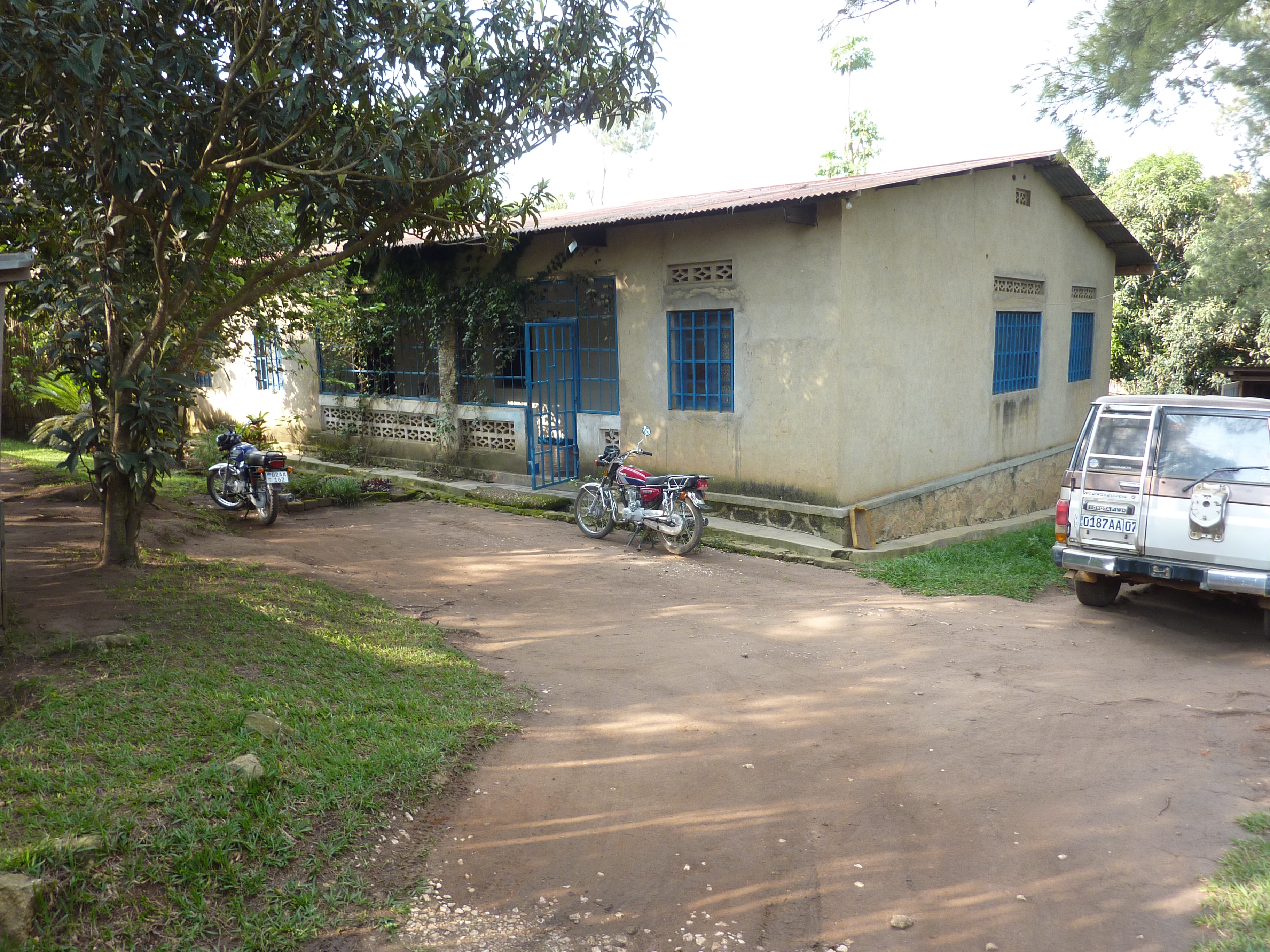
There is no need for alarm clocks in Bunia with the roosters ordering you awake at 5:30. We need to allow the Woods first dibs on the bathroom, but breakfast is at 6:30. It is a nutritional start to the day with a large slice of papaya and a lemon slice, followed by a soy porridge. Add a banana plus sugar and milk. Soy is the highest source of available protein here.

The Woods asked the landlord to not repaint the house so it will look less attractive for thieves

The Woods asked the landlord to not repaint the house so it will look less attractive for thieves

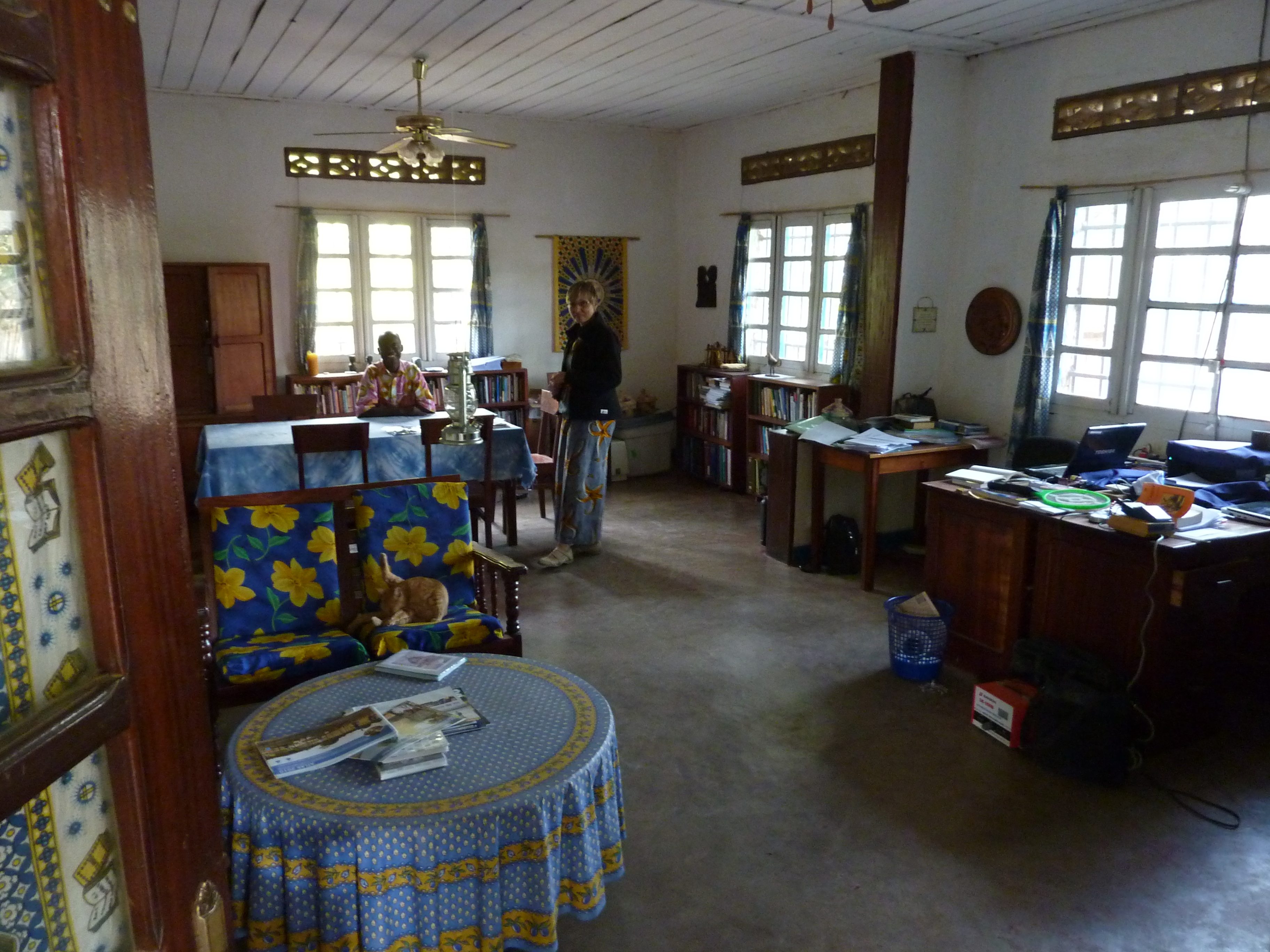
Inside the home of Drs. Philip and Nancy Wood

Inside the home of Drs. Philip and Nancy Wood

The Woods arranged for the Finance Director, Joseph Rona Katawanga, to come to Bunia so we can work at their rented home, which is extremely convenient for us.

Working with Joseph Rona Katawanga

Working with Joseph Rona Katawanga

Joseph speaks five languages and does quite well with English. We take the morning to review the operational and financial reporting structures. It’s actually fairly complicated. Originally, there was one location at Nyankunde which made for simple accounting and governance. After the massacre in 2002, the operation was transferred to Beni. With an expansion to Bunia and then the return and rebuilding at Nyankunde, now you have a multi location organization with multiple operating units at each location (eg nurses training, pharmacy, laboratory plus hospitals). With seven supporting churches and multiple supporting charities (including Samaritan’s Purse and WEC among others, although we were surprised at the low percentage of revenue received from donors), governance issues become interesting. We will be making recommendations on their organizational structures.

We’ll spend tomorrow at the Bunia offices with Joseph to review various documents but we are really looking forward to our visit to Nyankunde on Wednesday to meet the Executive staff.

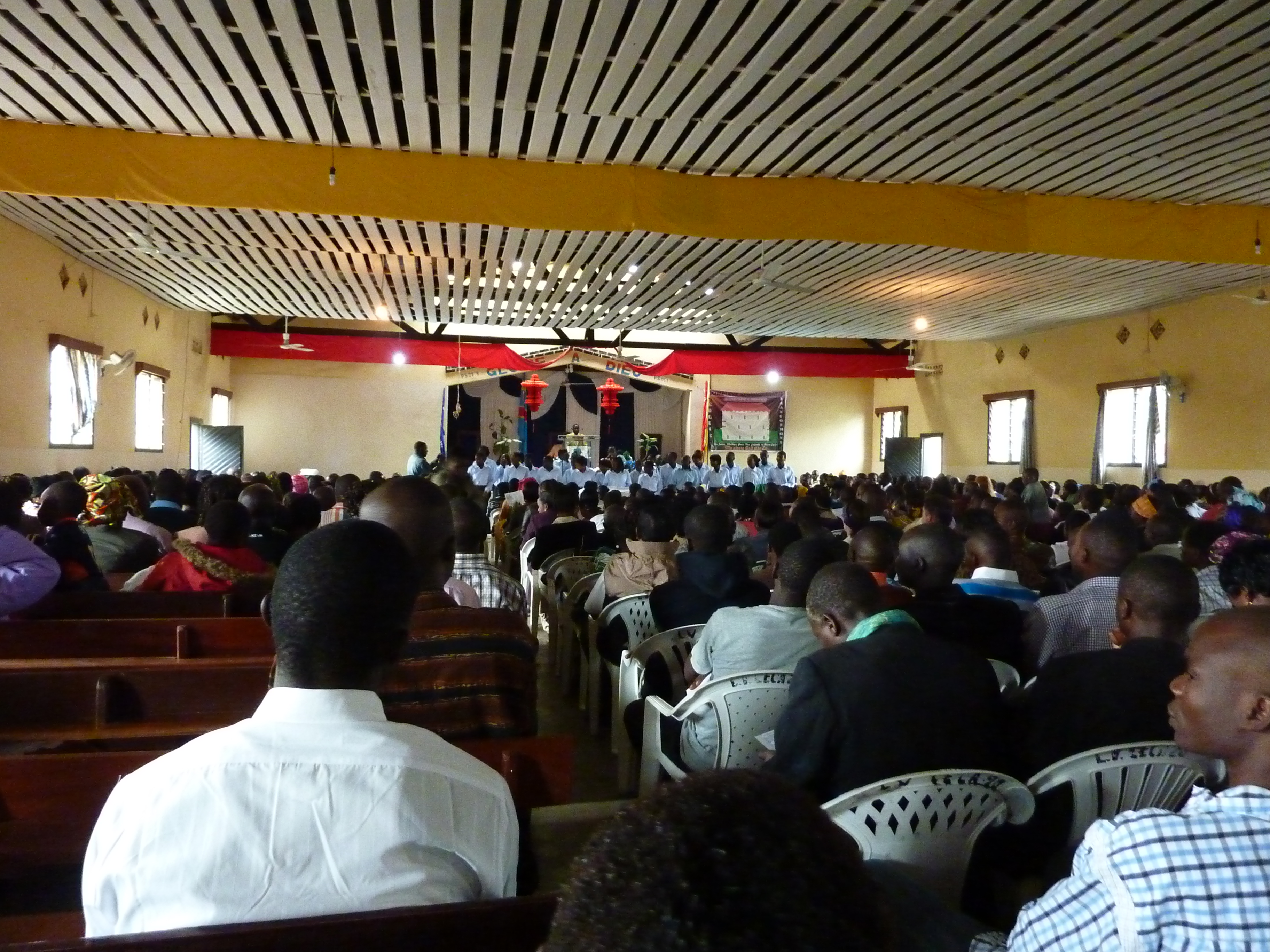
Arriving at the Bunia airport on time, we went straight to a church service. We were late by 20 minutes, but we were better than many, as about 50% more arrived after us.

Church of Christ in Congo, Bunia

Church of Christ in Congo, Bunia. A busy schedule!

Church of Christ in Congo, Bunia

Church of Christ in Congo, Bunia

Dressing up is a sign of respect in Congo and here you definitely dress up for church out of respect for God (Mungu). We may have been acceptable by Kitchener-Waterloo standards, but we certainly failed by Congo standards. The music and singing, as usual here, were extensive and first class. The lengthy singing either facilitates coming late or acknowledges that people will come late. The sermon was fiery in presentation but because of the outline shown by a projector, we could tell that it was deep, as it was about the characteristics of Jesus as God.

Giving was encouraged by two baskets. The first basket being passed around (hanging on a long stick put in front of you) was for your regular giving of 10%. A second basket was meant for your givings in excess of 10%. They were more discrete about this than a church in Butembo. At that service in 2008, the two baskets were left up front and you were expected to walk forward for the world to see which basket you donated to. That was a poorer congregation where givings of food instead of money was entirely acceptable.

The regular tithe basket

The regular tithe basket

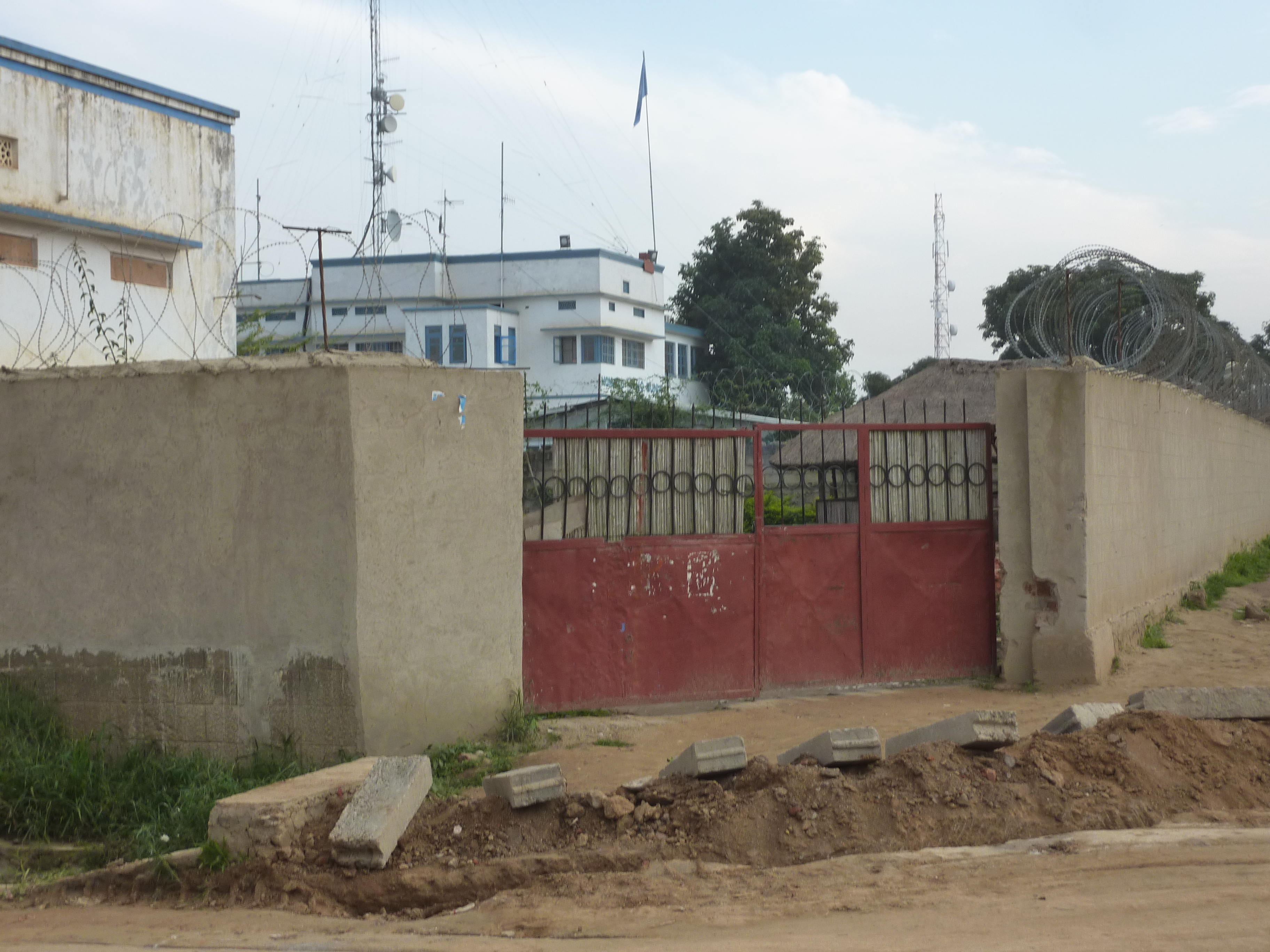
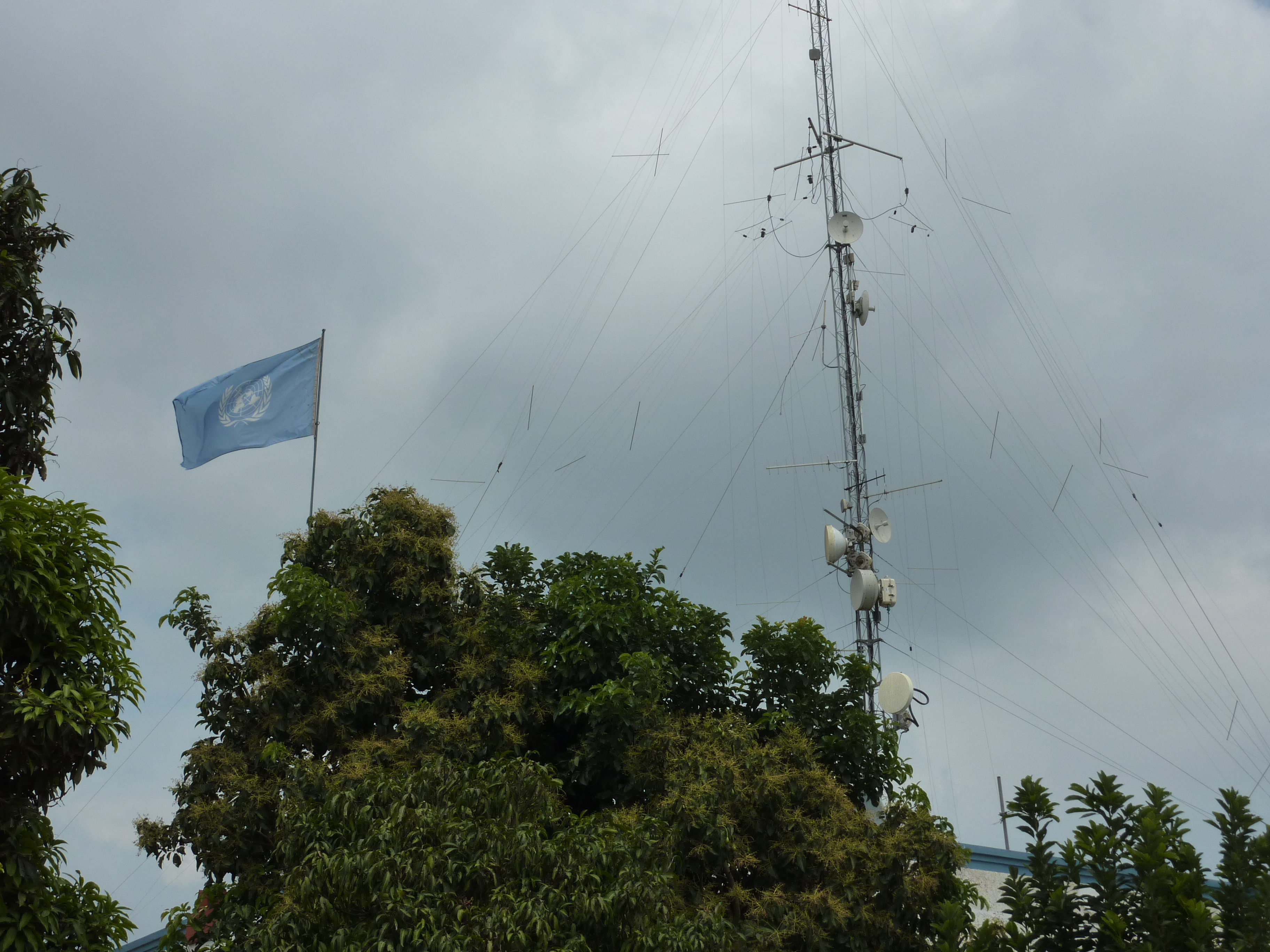
We were treated to an excellent buffet Greek restaurant immediately beside the UN / MONUSCO headquarters in Bunia. With 25 or so patrons, most were white except some stunning black women escorting white men. Aside from our car, the parking lot was otherwise full with UN vehicles.

MONUSCO HQ, Bunia, Orientale province, DRC

MONUSCO HQ, Bunia, Orientale province, DRC

MONUSCO HQ, Bunia

MONUSCO HQ, Bunia

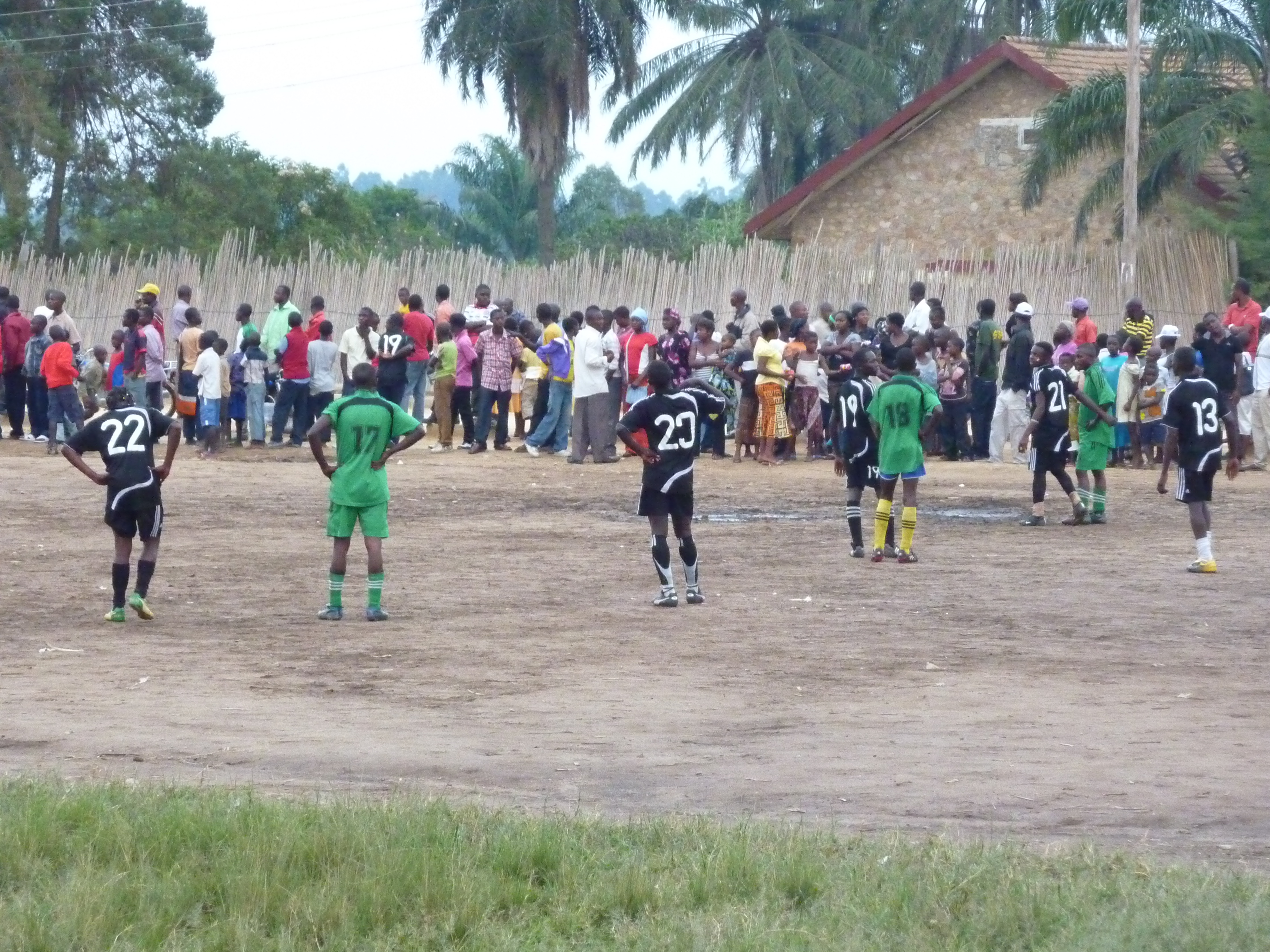
We were treated to a quiet afternoon. Brenda napped while Michael blogged, desperately trying to catch up after our packed schedule in Butembo. Hearing the roar of a large crowd, Michael went nearby to a very entertaining and good quality football match.

Football match in Bunia

Football match in Bunia

The pitch was mainly dirt, except for a 25% section of uncut foot long grass that certainly changed the play of the game. Oh, and the one mud pit near the centre of the pitch that was a remnant from the morning rain which made the ball stop dead. When the ball was kicked over a nearby quite high fence, the game stopped for five minutes. There was no spare ball around as they are considered luxury items.

Waiting for the ball

Waiting for the ball


Fans in celebration would throng the field and the player who scored a goal. After an impressive rush down the field, one player collapsed and appeared unconscious for several minutes. It was another excuse for fans to rush the field. No one seemed worried about the guy out cold. After all, he was from the visiting team.

Passed out cold

Passed out cold

Video of a football (soccer) match in Bunia.

Hotel Beni is smack in downtown Beni and has beautiful grounds and buildings. We stayed here in 2006 and not much has changed.

Beni Hotel in 2006

Beni Hotel in 2006

We opted for an upgraded room for the astronomical $60 per night. Stepping into the nicely tiled room, we thought things would be quite fine. We had our first misgivings when we looked into the bathroom and from there on we saw the flaws.

The toilet did not have a seat. There was the brown Beni city water in the toilet. We lightened the colour of the water when we urinated. There was no hot water, but they did provide a bucket of hot clean rain water on request. During the night, it rained extensively and we woke to large puddles on the floor in the bedroom and bathroom.

With the restaurant opening at 7:00 and being told by the airline to check in at 7:00 for our 9:00 flight, we checked out of Hotel Beni without breakfast. Our driver, James and Charite stayed with relatives but we wish we had a better understanding of what that looked like.

The new Beni airport is just north of town now. We arrived at 7:00 with no cars in sight so we sat in the muddy parking lot as the rain poured. The airline didn’t have a representative arrive until 8:00. Instead of airline employees, it was us and 30 Congolese soldiers who were guarding the airport. One day Michael is going to find a soldier willing to be photographed, but it obviously was not here. Many were wearing the UN blue beret, but we later learned that it was a case of the Congolese soldiers scrounging for a hat.

This new airport could better be described as a new cow barn. There was no electricity (we couldn’t find any lighting fixtures) and bare mud floors. The Chinese had built the beautiful road north of Beni but the final road in was a sandy road just begging to be washed away.

Once it was 8:00, the masses seemed to appear. We had our bags moved aside when an obviously (at least self) important person arrived. Our tickets were checked, a $20 fee was requested: slip into a back pocket. We watched as our bags weren’t getting weighed and tagged. Remembering that Ross and Dawn Penner’s bags didn’t make their direct flight from Goma to Bunia in October, we stuck with them by the scales. Another representative said that when we bought and paid for our tickets in Bunia last week, they failed to tell anyone else so we weren’t registered and he didn’t know if the plane would arrive with seats for us. (What did we get for our $20 on check in? Didn’t the first guy know that too?)

A third employee came by seemingly in a panic and was shocked that our bags weren’t tagged yet. He quickly weighed and tagged them, asked for our tickets, told us to go through passport control, and left. It was a domestic only flight, but passports were checked anyways, a $20 fee was requested: slip into back pocket. Next was a check for our yellow fever vaccination. Michael pretended he didn’t hear the request for money and got out of there fast. Next, getting by an armed soldier was more problematic. A simple solution was available though. Insert $10: slip into back pocket.

I think someone was upset that we were travelling so light and we weren’t dinged for our bags being over weight. Someone asked for our carry ons, weighed and tagged them (hoping for more weight?), returned with them, but for some unknown reason then walked off with them. That’s our passport and most of our money! We asked James to follow and not let them out of his site.

A short time later, mini buses come up and we were yelled at to get on board. We aren’t leaving without our carry ons! The rain is now pouring down. Where on Earth is James? We went rushing to a nearby building to try to find him, ignoring the shouts to get on the mini bus. The mini bus is waiting to leave for the plane when at the last possible moment, James runs up with our carry ons. We had seconds for a too short farewell before being whisked away uneventfully to be picked up by Dr Philip and Nancy Wood at the Bunia airport.

Saying farewell to James Kataliko and Charite at the Beni airport

Saying farewell to James Kataliko and Charite at the Beni airport where pictures were allowed


To continue with the airlines theme, from Vice News an interesting video report on Russian pilots in eastern Congo:
https://news.vice.com/video/russian-pilots-of-the-congo

Saying our farewells to several CSCODI volunteers at the Butembo market, we checked out of the Center Kikyo, had a nice lunch there, and proceeded to drive north to Beni.

This was our third trip from Butembo to Beni (twice in 2008) but thankfully the first time our car didn’t breakdown on the beautiful but rough rocky road. Instead, it was the breakdown of a UN truck filled with Nepalese soldiers that caused problems. Why it chose to breakdown right beside a transport truck that had broken down, we don’t know. It created a frustrating backup of cars and trucks unable to get by.

Trying to get the UN truck out of the way.  We wound up squeezing by on the right.

Trying to get the UN truck out of the way. We wound up squeezing by on the right.

Have we said how beautiful the Beni to Butembo road is?

Have we said how beautiful the Beni to Butembo road is?

We arrived at the CSCODI clinic in south east Beni as it was getting dark. Their focus is on being a mother / child clinic.

CSCODI Mother and Child clinic, Beni

CSCODI Mother and Child clinic, Beni

Entering the CSCODI Mother and Child clinic, Beni

Entering the CSCODI Mother and Child clinic, Beni

It was obvious that there is no money or they are trying to do far too much given their available resources. There was no electricity because there was no fuel for their small generator. An incubator was unused due to the unreliable power. The medical supply cabinet was bare and we were told of unpaid salaries. Yet it is remarkable what they do without resources. At least four women were recovering from Caesarians. Several rooms had mothers in a bed with a small child. We guessed at 35 to 40 patients being on premise.

CSCODI doctor showing us the barren supply cabinet

CSCODI doctor showing us the barren supply cabinet

Staff at the CSCODI clinic, Beni, North Kivu, DRC

Staff at the CSCODI clinic, Beni, North Kivu, DRC

CSCODI doctors and staff

CSCODI doctors and staff

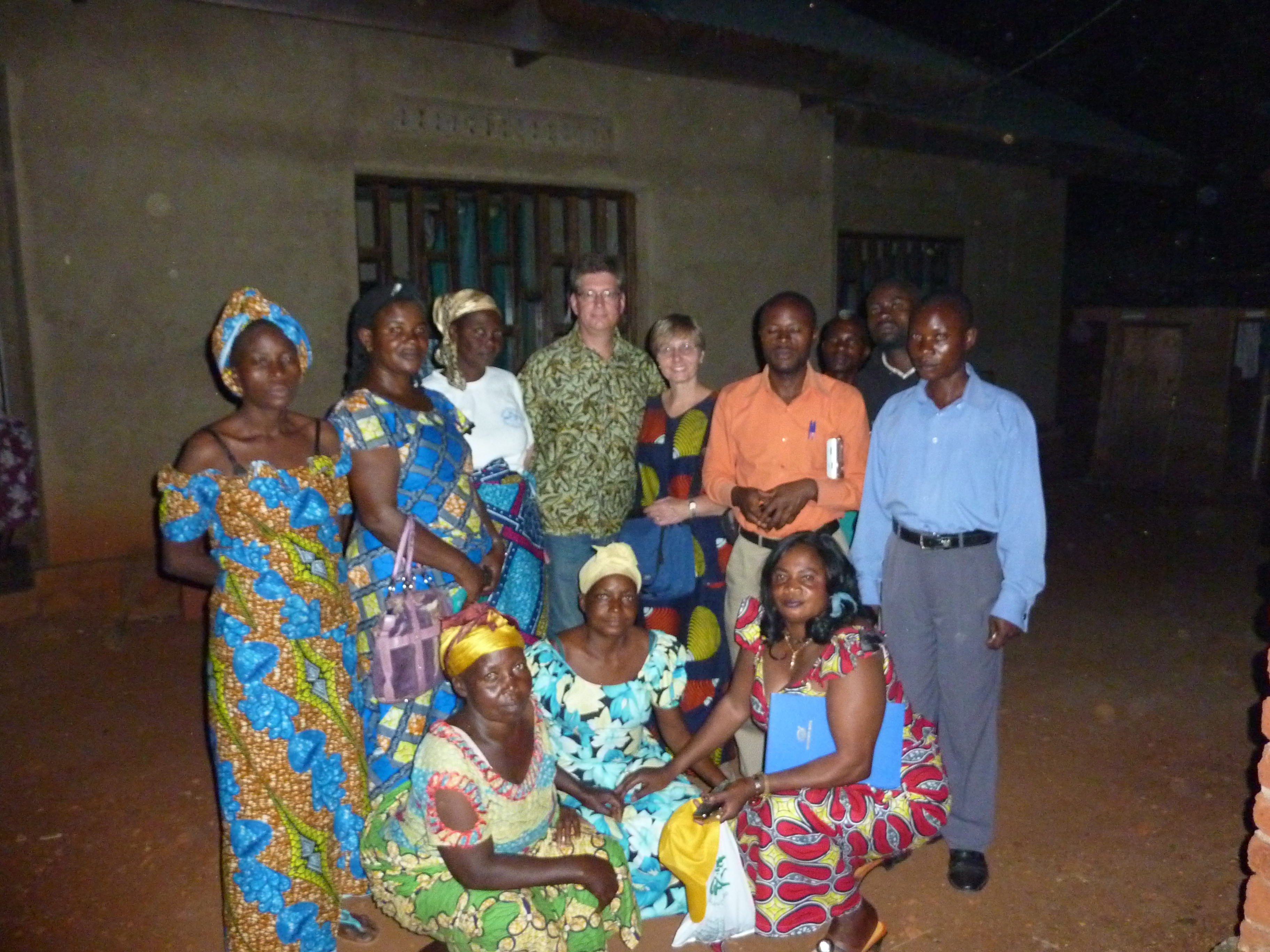
We met Kavuo Esther, who much like Kahindo Mama Nely we met in Butembo, is a woman with AIDS trying to help others. She is the leader of a group of 386 women trying to support each other. She talked of a lack of money and anti-retro viral medicines. She is trying to establish microfinancing for these women. It is remarkable to see the determination of the Congolese.

Kavuo Esther with her supporters

Kavuo Esther with her supporters

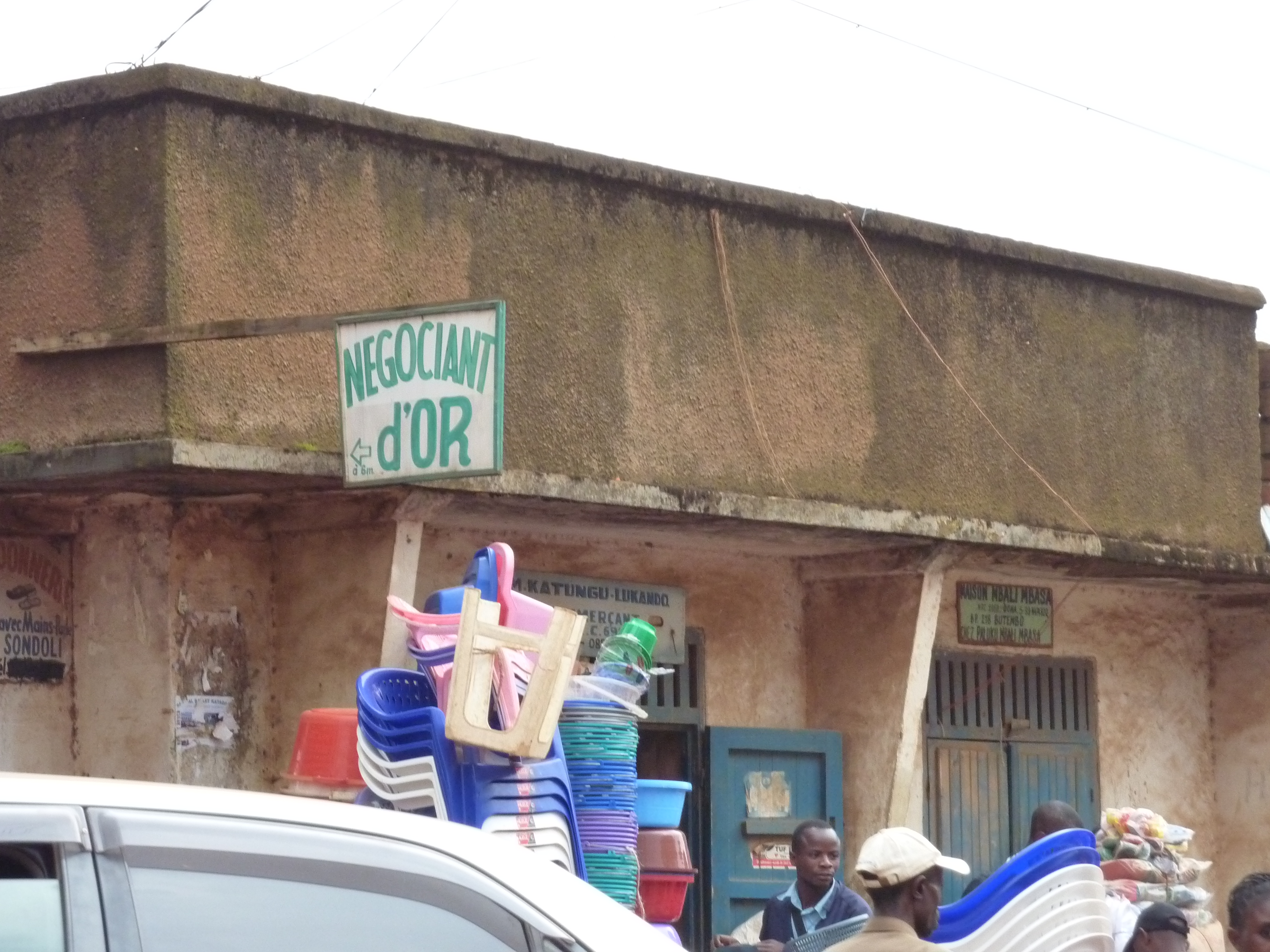
Butembo, along with Beni and Bunia, is currently infamous for it’s gold trade. Much of Congo’s gold trade flows through here, on to Uganda and then on to the Dubai gold market. We saw dozens of gold exchange shops so there must be many times more that we didn’t see.

16% of Uganda’s foreign exchange earnings are from the sale of gold. However, Uganda doesn’t have any gold mines.

Most gold is sold in these exchange shops as gold dust direct from local mines or small scale streams. The gold will be transferred through various intermediaries so there becomes no trail to determine where your gold came from. A key characteristic explaining why gold is money is that it is fungible, meaning completely exchangeable.

Children panning for gold south of Bunia, Orientale province, DRC

Children panning for gold south of Bunia, Orientale province, DRC

We first took this photo, then noticed the children panning for gold.  They clearly did not want their photo taken.

We first took this photo, then noticed the children panning for gold. They clearly did not want their photo taken.

Butembo gold exchange

Butembo gold exchange

Butembo gold exchange

Butembo gold exchange

Dr Wood has mentioned that CME Nyankunde frequently sees patients from mining accidents for things like fractured backs due to mine collapses.

Brenda is reading a book called Consuming the Congo: War and Conflict Minerals in the World’s Deadliest Place by Peter Eichstaedt. It discusses how the Congo army controls certain large mines and ensures that a sizable percentage of revenue is skimmed off. It is believed that this is how President Kabila has become so wealthy so quickly (in addition to controlling extensive business interests in several sectors).

While we can hardly say that the region has become wealthy from its gold, there are many large houses and buildings being constructed that are believed to be from gold money. It is clear that the money is not making its way into the general population, which explains much of the quiet discontent against Kabila as well as the unquiet discontent against him in Kinshassa.

New home in Bunia

New home in Bunia

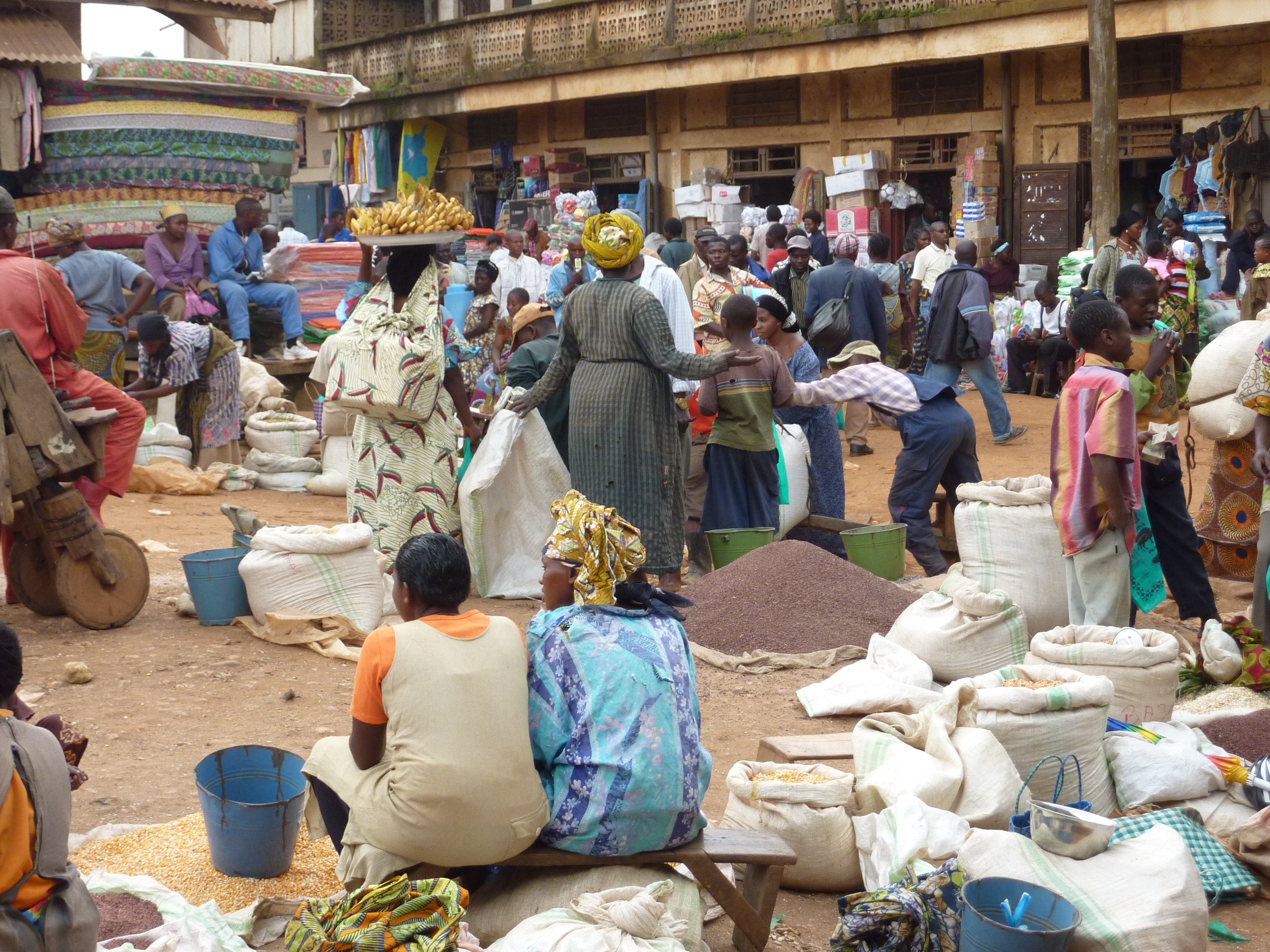
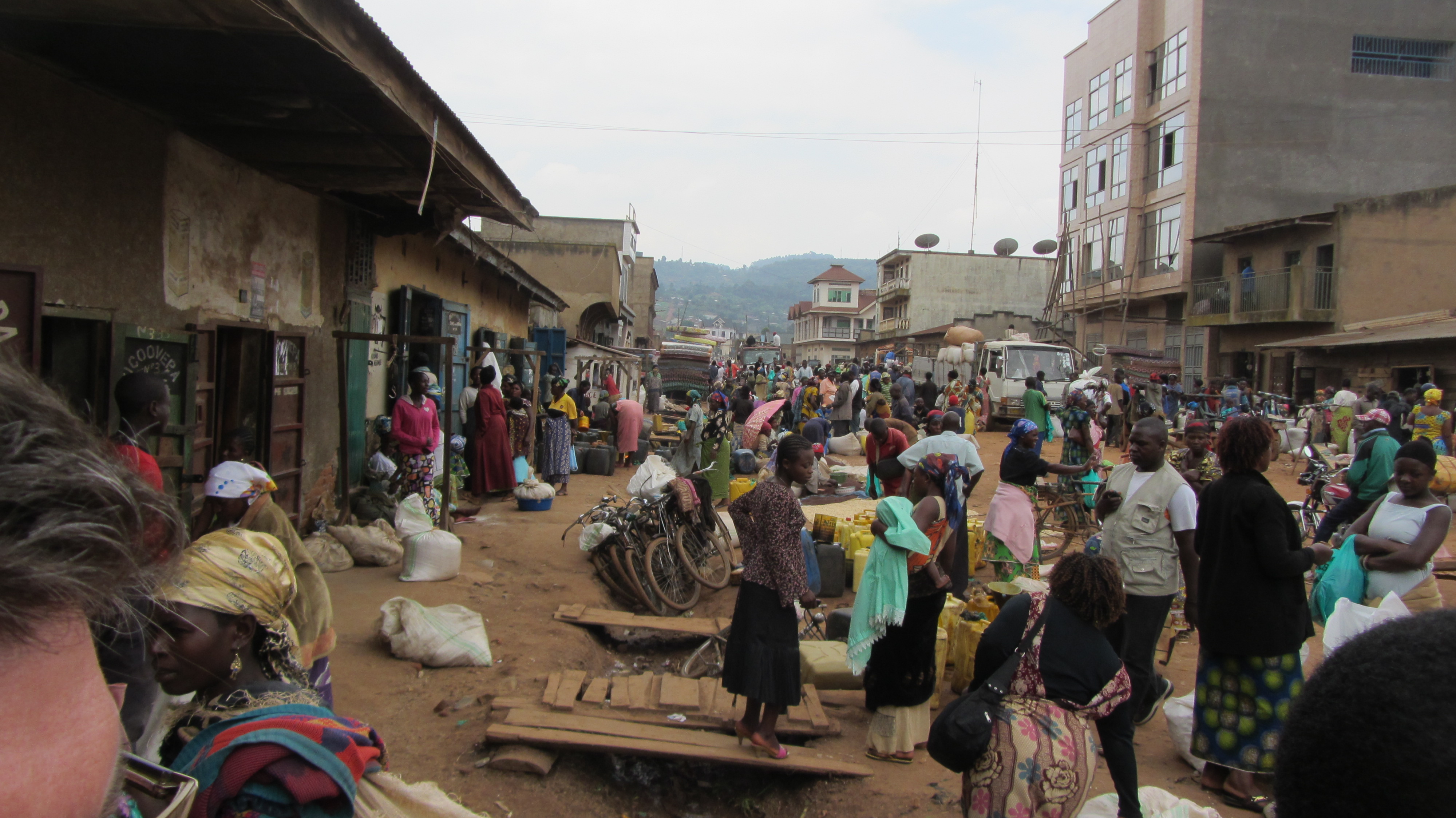
Despite currently being the least served by any scheduled airline in the region given its size (the dirt runway is just too short), Butembo is known as the commercial centre for the broad region. It has by far the largest market and commercial zone and (don’t hold me to it) a population of 600,000. We are told that its people (the Nande tribe) have historically been the most commercially aggressive and successful.

Butembo market

Butembo market

Butembo market

Butembo market

Butembo market

Butembo market

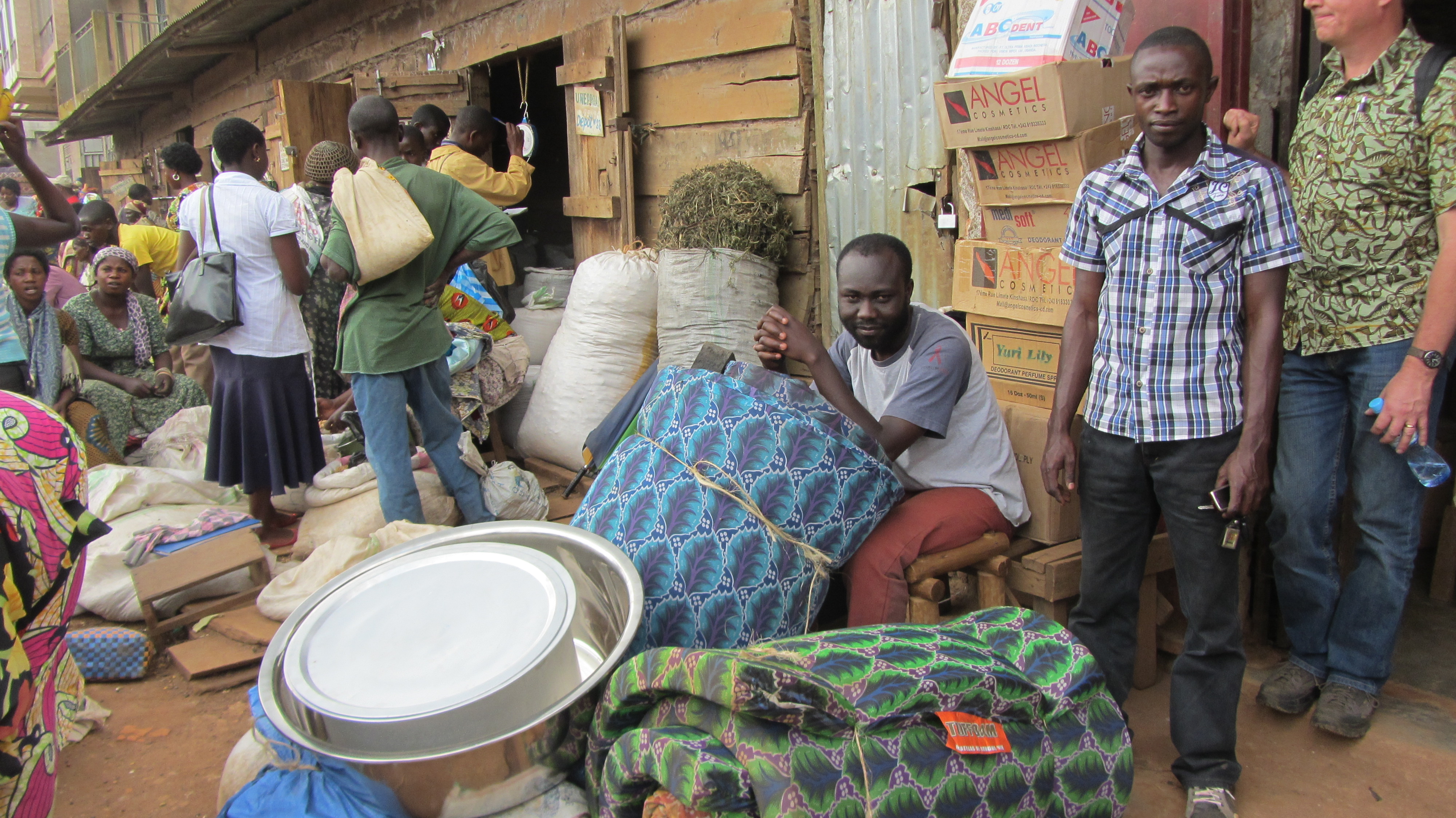
We went to the market with a crew of CSCODI people, but Muhosole, a key helper for Dorcas at the orphanage, was the main organizer. He worked off a list prepared by Dorcas, would know where to go within the market area of at least eight large city blocks and then negotiate a price given the relatively high volumes.

Muhosole from CSCODI buying beans

Muhosole from CSCODI buying beans

Muhosole purchased (and Brenda took good notes to record):
50 kg beans
50 kg maize
50 kg rice
100 kg manioc/cassava root
22 kg palm oil
20 l kerosene
25 kg sugar
10 kg dried talapia fish
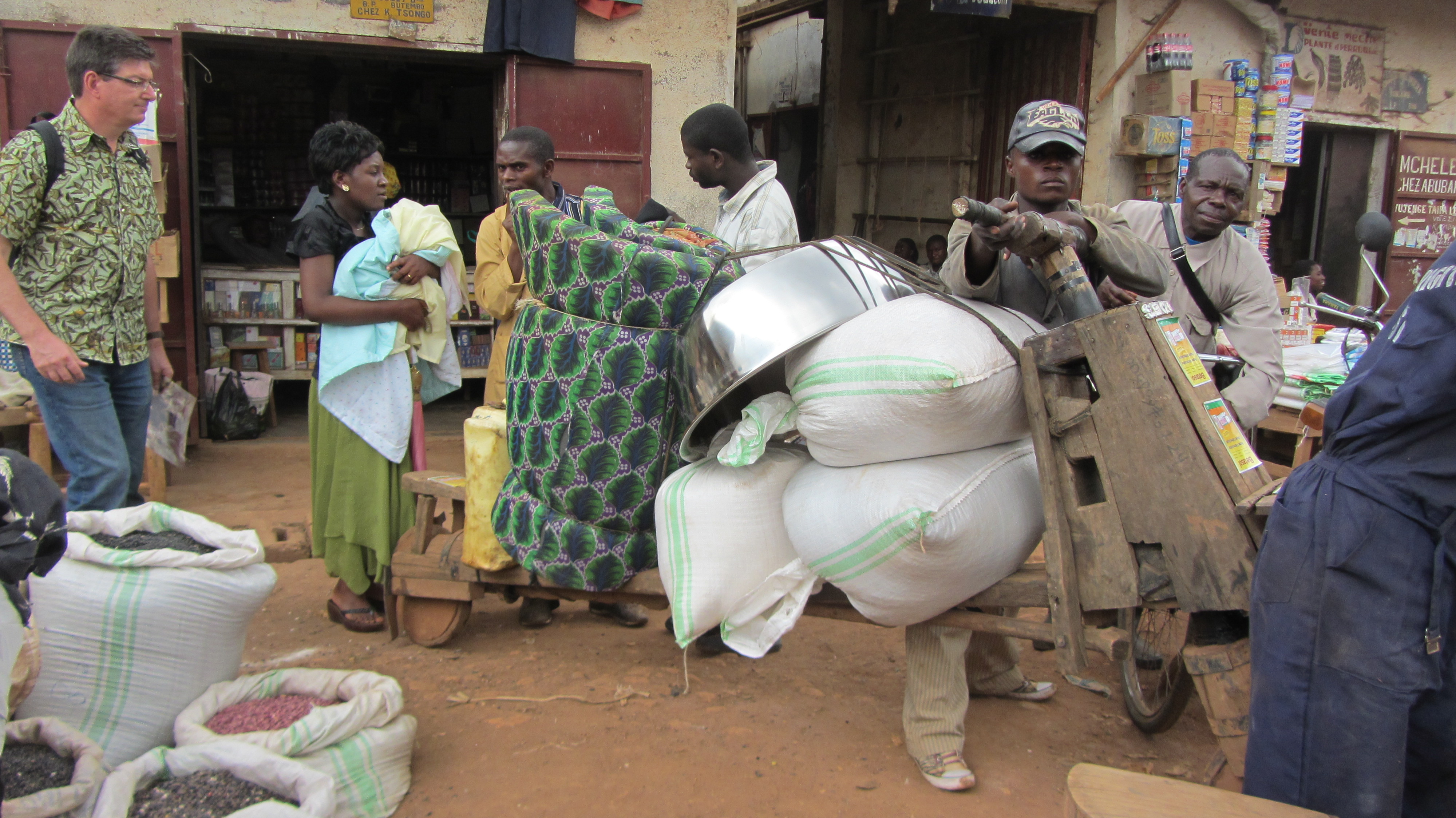
6 foam mattresses
Soaps
2 large cooking pots
1 large wash basin
12 stainless steel plates
12 cups

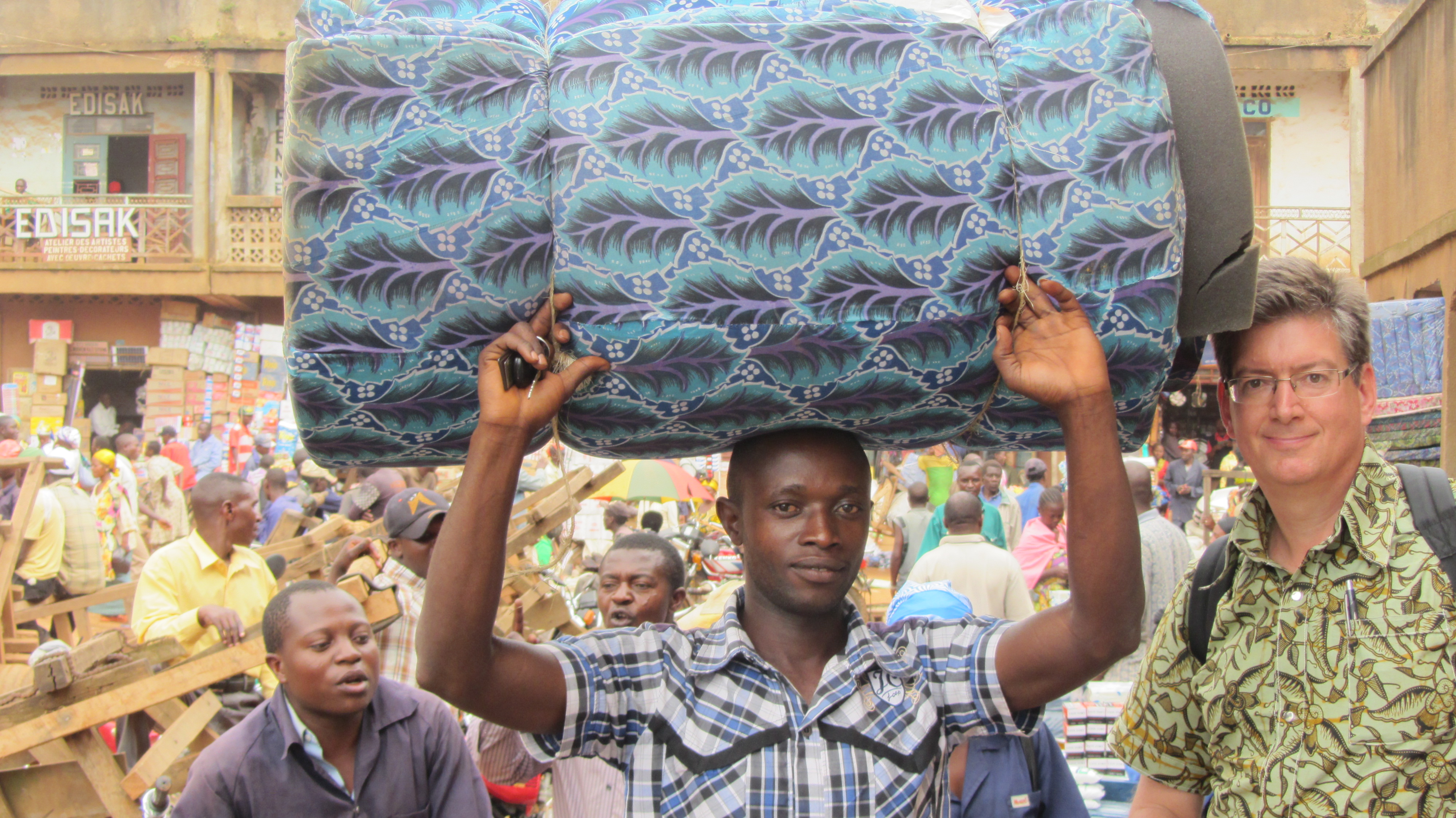
Mattresses for the CSCODI Mama Dorcas Orphanage in Butembo

Mattresses for the CSCODI Mama Dorcas Orphanage in Butembo

James Kataliko guarding our purchases as they accumulated

James Kataliko guarding our purchases as they accumulated

Thanks again for those who financially supported us for these purchases.

We learned to spot the difference between banana plants (green trunks) and matoke plants (much like plantain – black trunks).

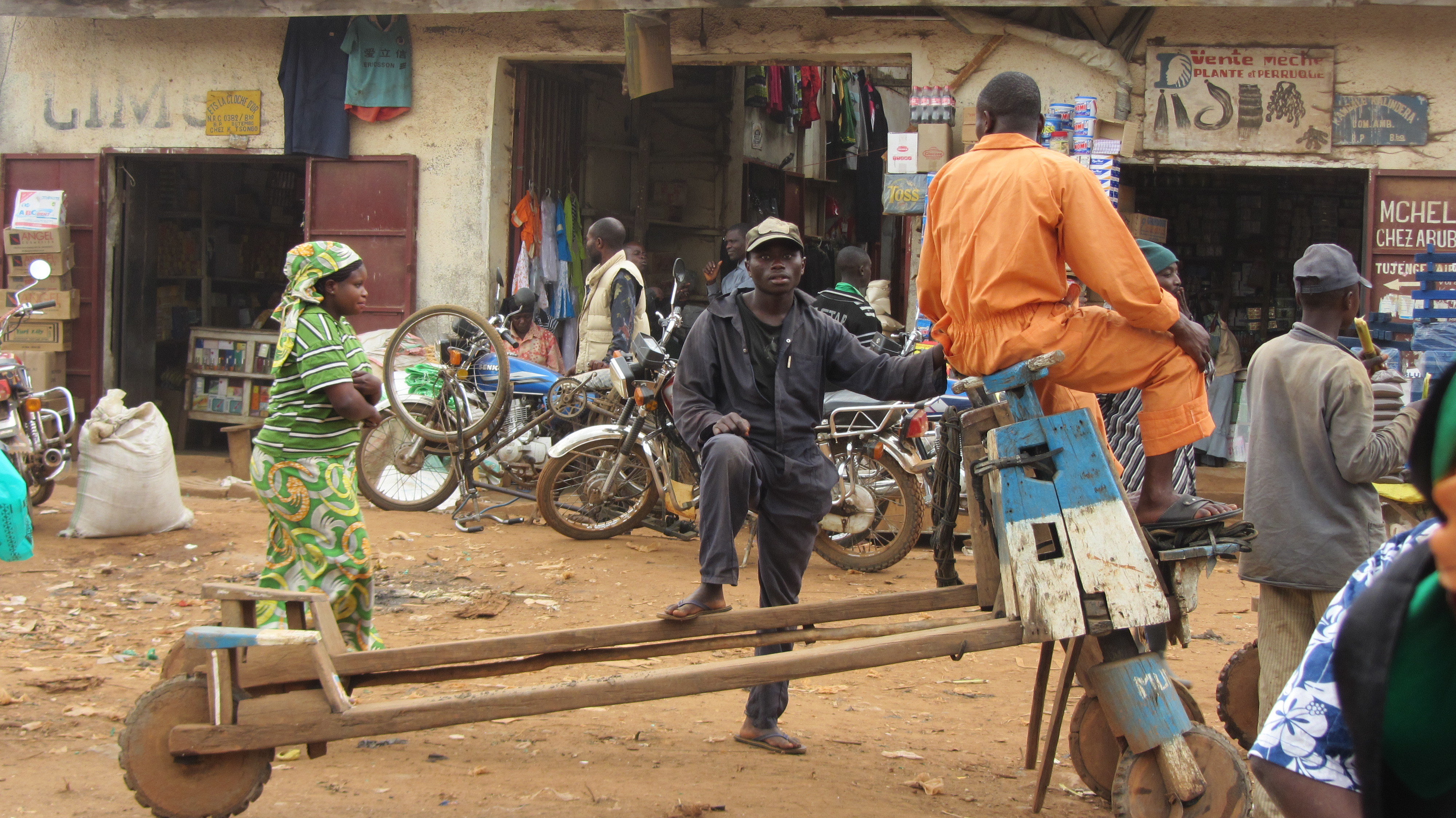
Given the small Toyota we had, we were trying to figure out how we were going to get market items to the orphanage. The solution is the chukudu, essentially a wooden wheelbarrow.

Chukudu, the wheelbarrow workhorse of Butembo

Chukudu, the wheelbarrow workhorse of Butembo

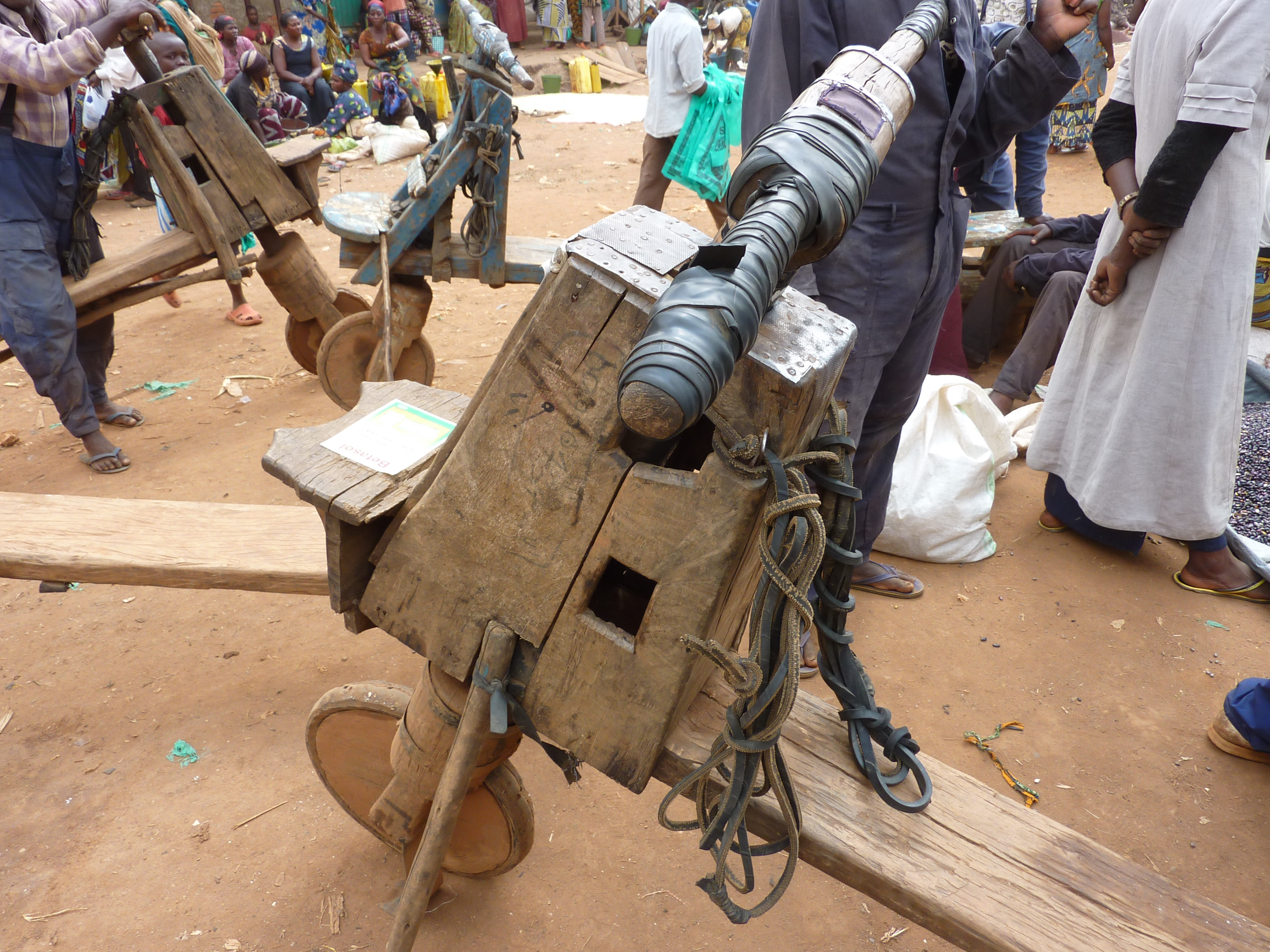
Chukudu close up

Chukudu close up

We hired two chukudu (I’m told that the singular is the same as the plural in this case) for the relatively expensive price of $15, but it is quite the walk up and down hills to get to the orphanage. Muhosole was to escort the chukudu to the orphanage. It’s too bad we couldn’t be there when the chukudu arrived.

One of the hired chukudu all loaded up

One of the hired chukudu all loaded up

Video of the chukudu being loaded before delivery to the orphanage.

James, Charite and our driver met us again for breakfast at 7:15 and we headed out to see the CSCODI microfinance operation. Headed by Saasita, it is run by and supports many of the women we saw yesterday. We were greeted and we greeted back. They asked us for our thoughts about their program as they were new at this, and don’t have any training in finance. They have received seed funding of $2,000 from CSCODI and have loaned it out to over 40 women. They are starting get repayments, but it is too early to talk about bad debts. We realized that we were fortunate to have visited Opportunity International (OI) in Kampala in 2008, so we drew on that experience to explain how OI operated.

Saasita leading the CSCODI microfinance group

Saasita leading the CSCODI microfinance group

Fortunately, the CSCODI group is following most of the key tenets of OI, but we encouraged them with a few items. Trust groups recommend possible members to confirm they are good credit risks. It is important to know what they will do with money and confirm the plan is sound. Lots of people will ask for money if it available but it needs to be paid back. We explained how the interest rate needs to be higher, hurting everyone, if people do not pay back their loans. We also stressed the importance of frequent and regular communication with the borrower.
It was great to hear how a women was able to buy and then sell clothes at the market due to her loan. Now women are able to pay for school fees which they were previously unable to do.

A woman involved with the microfinance program

A woman involved with the microfinance program

We then drove with Saasita to see the general manager of the main government run microfinance organization, Pawicu Nbuja Issac. Called CADECO, it had all the feel of a big bank. The GM was obviously very busy as we were constantly interrupted. We weren’t sure if we should have been brought there, but we explained on the fly that we valued his expertise to help Saasita and her fledgling microfinance program. He was then very good at explaining that CSCODI must register the program in Kinshasa but they also need to keep separate all the various programs of CSCODI. He encouraged us that the paperwork is easy.

Funny how government can be invisible until you don’t want it to be.

Saasita, Pawicu Nbuja Isaac, Michael Ben, Brenda Ben at the CADECO office, Butembo

Saasita, Pawicu Nbuja Isaac, Michael Ben, Brenda Ben at the CADECO office, Butembo

Michael made an offer that couldn’t be refused (USD $10) to buy a Kabila election hat. In 2006, Kabila was well known for giving away free t-shirts. For this election, he gave away free baseball caps.

What kind of crazy guy spends $10 to buy a free hat?

What kind of crazy guy spends $10 to buy a free hat?

Next we were off to the market for our shopping spree.

The beautiful Center Uhai Kikyo sits prominently on top of a hill at the north end of Butembo. Already in a gorgeous lush setting, the buildings and grounds are immaculate and are the nicest we have come across in Congo. They must have received significant financial assistance to build. This Centre served as the location for the 2008 Healing Streams trauma counselling seminars.

Centre Uhai Kikyo units

Center Uhai Kikyo units

Our unit complete with hot water!

Our unit complete with hot water!

Dining hall at the Center Uhai Kikyo

Dining hall at the Center Uhai Kikyo

Fine dining at the Center Uhai Kikyo

Fine dining at the Center Uhai Kikyo


On our arrival, we watched a bride and groom walk towards the reception hall. It must be the Casa Loma of Butembo.

It’s history isn’t as pretty. During the Congo War, instead of a hotel and conference centre, there were military barracks. It was the scene of a civilian massacre with many people buried alive on the hill. Afterwards, people refused to go up the hill due to the evil spirits. Local Baptists wanted to cleanse the hill of this history and arranged to buy the hill and create the Center.

Uhai = life. Kikyo = rest, or to be at rest.

We were told that the inability to purchase alcohol has had a major impact on creating a lack of traffic, which is incredibly unfortunate. It’s the only place we’ve been to in Congo with reliable running hot water and we’d take that over a beer any time.

After the university, our day still wasn’t done. We were taken to another part of Butembo to visit a program for women that could be described as a self help group. The children are now long home from school and don’t have TV or Internet to distract them, so we were again greeted with a mob of signing women and children excited to see muzungu.

Greeting at CSCODI's Women's Support Group

Greeting at CSCODI's Women's Support Group

Welcome to CSCODI Women's Support Group

Headed to the CSCODI Women's Support Group reception

Yet another CSCOCI program on a shoe string, this one is organized by Saasita who seems to be everywhere. She is the director of the CSCODI school, the womans group and the microfinance (which we will visit Saturday morning).

Women in Butembo

Women in Butembo

She introduced us and we gave greetings. Michael was asked to pray and then our entourage left to visit four different homes of widows who receive support from other women. Uniformly, their homes are small homes built with mud plastered between a thatch of sticks for a wall, plus a grass roof. They all slept on straw. Due to their wood fires, their lungs must be equal to a four pack a day smoker. Most roofs obviously leaked.

Brenda reviewing widow's home

Brenda reviewing widow's home

Another widow's home

Another widow's home

Bed with straw mattress and plastic blanket

Bed with straw mattress and plastic blanket

Unfortunately, it seemed most widows hoped to receive financial help from us, but we made it clear that we were providing money to Saasita. That got us off the hook, but poor Saasita! She needs to allocate limited funds among hundreds of legitimate needs. That can’t be easy.

We came across an election station which had posted the results of that poll for all to see. The incumbent president Kabila is obviously not popular here! In the two posted poll, he received under 10% in both. Kabila’s real strength is in the populous south east, Katanga province.

Results posted at a Congolese polling station

Results posted at a Congolese polling station

Sunset can be a relief, because it means your day is finally over. Starting with the Anglican bishop, followed by the orphanage, sewing centre, primary school, lecturing and touring with widows, that was one full day.

Enter your email address to follow this blog and receive notifications of new posts by email.

Join 66 other subscribers

Archives

Prior Posts