Jean-Pierre Bemba has been found guilty of war crimes by the International Criminal Court (ICC). Bemba was vice-president of Congo from 2003 to 2006 and was the main opponent to Joseph Kabila in the 2006 Congo presidential race. He won majority support in western Congo in that election while eventually losing to Kabila. He is a big fish.
Bemba Concedes
2006 Election Results
The significance is that he is the first conviction by the ICC for his deemed assent to rape as a weapon of war. He was accused of not acting to stop militia under his control from raping, murdering and pillaging, events which took place in the Central African Republic in 2002 to 2003, not in the D.R.C.
With few exceptions such as the Nuremberg Trials and for former Yugoslavia, war criminals are rarely brought to justice. This is a hugely confirming event for the ICC which was formed in 2002. The United States has yet to ratify their participation in the ICC, primarily on the grounds that excessive zeal by political foes could unjustly threaten members of their armed forces.
It took the court two years to reach the verdict (which verifies some expressed U.S. concerns over having fair and expedient trials). Sentencing will follow in a subsequent hearing. Bemba is also facing an additional trial for the charge of bribing a witness in this main trial. His conviction also rules out the chance of his running for president which some had suggested in the event he was found not guilty.
Nancy Wood reports a difficult week in Nyankunde and Bunia:
This past week did not start very well as we had word on Monday morning that a faithful MAF worker, who had lived in Nyankunde all his life, had been killed on Sunday evening by men in military uniforms. This man was 50+ and in addition to working for MAF he has helped rebuild several of the churches in the village, and had begun building some attached shops near the Nyankunde market. The local population were outraged and killed 3 of the men.
Tuesday wasn’t much better as we learned that on Monday night, 4 thieves, 2 with guns, arrived at PRORESO School for the Deaf, out in the eastern part of Bunia, and they stole the 2 solar panels off the roof. The panels were installed to make the computer lab functional and all high school students have had computer lessons. But the staff also use the electricity to photocopy or print handouts for the children, and the Director can print official letters etc. Now no power! If we replace them right away, they may be stolen again right away. Obviously the proposed 600m security fence around the PRORESO property is needed immediately but Lord has not yet provided the funds.
Teachers Liripa and Devi at the PRORESO School for the Deaf
Ochaite at the PRORESO School for the Deaf
Meanwhile, Save The Children has reported three aid workers were kidnapped last week (on March 2, 2016) in the Lubero area just south of Butembo. At this time, there has been no public update on their status.
Update: The UN announced on March 8 that all three aid workers have been released. At least 175 people were kidnapped for ransom in eastern Congo last year, according to Human Rights Watch, who are reporting that many kidnappings have been carried out by former and current members of armed groups.
Kalondo has had some rough times. In 2011, it was devastated as part of the M23 conflict. In September 2014, we were able to send them some medical supplies, only to have their medical clinic badly damaged in a severe storm known as an ourangan. Lately, it has been extremely rainy and access to the village has been virtually impossible.
Local community members haven’t lost hope and we are pleased to support them with an innovative twist on micro-financing. James Kataliko and Saasita were able to deliver enough funds to purchase and provide 40 chickens. Twenty families selected by a local committee will receive two chickens each. In time, they will simply be expected to provide two chickens back to the committee who will then start the process again by “loaning” two chickens to another family.
This project has been named “Kuku yangu, tenga yayi!” which translates to “My chicken, give me eggs!”
Dorcas Mbambu has provided an excellent 2015 report for the sewing project. This project started in early 2014 after a successful Indiegogo campaign raised CAD $5,076 towards purchasing machines and related equipment. The goal was to invest in a project that would provide an income for the Muti wa Nzuki School for Orphans in Butembo so they could be less dependent on foreign donations and to also be an opportunity for student training.
In 2015, Dorcas is reporting that the sewing project generated net revenues of USD $5,928 with related direct costs of $2,678 (for salaries, rent, transportation and repairs) for a net profit of $3,250. She apologized that she spent only $970 towards the feeding of orphans (which is down significantly from 2014) but the reason was due to the increased receipt of funds from other donors.
For those in the U.K., please consider supporting Semiliki Trust or CMS Ireland who have both become key supporters for people in eastern Congo and have specifically helped the Muti wa Nzuki School for Orphans in Butembo.
Five dressmakers were able to train six girls and two boys in the year. They averaged production of 3 pants, 2 shirts and 2 shirts per day, six days a week.
(b)Summary revenues from the performance of the workshop
Amount in $
01
The benefit of $19 profit per day allows realized profit after 26 days working $ 494 monthly.
After a year the earnings amounted to $ 494 × 12 months.
This thanks to the sale of the sewn clothes (pants, shirt and skirt)
$5,928
02
Profit generated by the sale of bricks produced through the performance of sewing
1,800 (cfr annual report 1014
03
Received from MICHAEL BRENDA couple dated 24/08/2015
350
04
Received from MICHAEL BRENDA couple in November 2015
400
06
Benefit of income generated by sewing, custom, clothes of nearby persons
1,800
—
TOTAL REVENUES
$10,278
(c). Table of certain expenditures related to the sewing project
N
Type of expenditure
AMOUNT IN $
%
OBSERVATION
Annual salary of 3 designers
$1,778
30% $ 5,928
Annual return of sewing
Annual rent of the room or work the seam
300
2.91
Annual repair of sewing machines
150
1.45
Transportation costs to reach different markets in rural areas
450
4.37
Feeding of orphans
970
9.43
TOTAL
$3,648
35.49
We also sent USD $750 in the year so that the Dorcas could arrange for the completion and manufacturing of bricks which were then sold at a profit. With these funds and the residual profits from the sewing project from 2014 plus the 2015 sewing residual profits ($2,280), she was able to directly support orphans at the school ($2,220) and to help the construction of 3 classrooms ($2,537) which CMS Ireland was also strongly supporting.
Other essential expenditures from $ 6,630 above
N
Type of expenditure
amount
NUMBER
Each
Total
Purchase of uniforms for orphan schoolchildren from primary school
Uniform purchase of secondary school students
26 orphans
14 orphans
$10
15
$260
210
purchase school kits in favor of orphans high school students
purchase school kits for orphans secondary school students
26 orphans
14 orphans
10
15
260
210
Buying shoes for orphans
40 orphans
10
400
Payment of school fees for the high school. It’s half of the annual fee
14 orphans
45
630
Payment of medical expenses for orphans who have been hospitalized in the year 2015
15 orphans
250
TOTAL
$2,220
N
DESIGNATION
REPORT
$ 4,409.6
1
2
3
4
5
6
7
8
9
Wooden plank
Linton wooden
Wood rafters
Regular nails
Corrugated sheet
Painting
Nails sheet
Transport of materials
Purchase bricks for pavement
Qty.
each $
Tot $
BALANCE
OBSERV
312pcs
18pcs
75pcs
51kg
69pcs
300l
24kg
——–
10,000 bricks
6
7.5
3
2.5
8.2
3
3
——-
$ 100 / 250 bricks
1,872
135
225
127.5
565.8
900
72
100
400
2,537.6
2,402.6
2,177.6
2,050.1
1,484.3
584.3
512.3
412.3
12.3
Congratulations and thanks to Dorcas for enabling such good results.
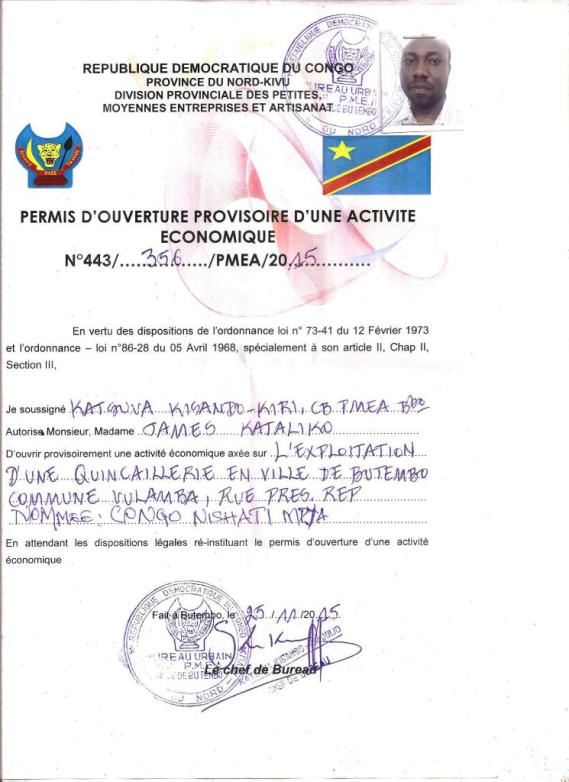
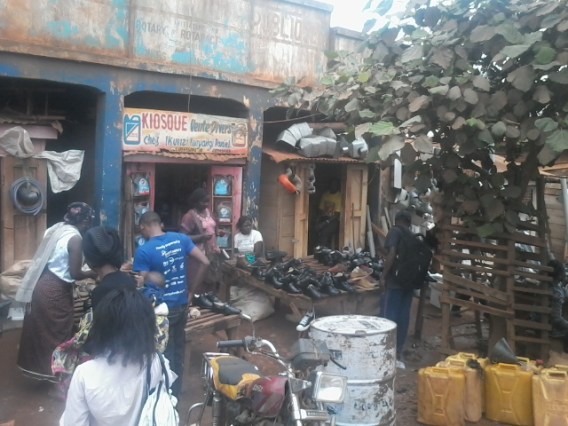
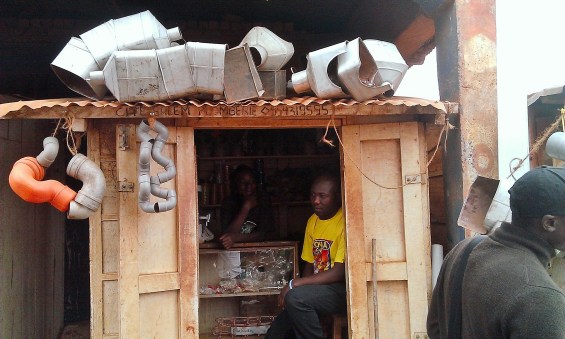
Our continued goal is to help support the start up of micro businesses in eastern Congo. Clean water was identified as an important and under served need in the area. Led by James Kataliko, they have already turned over their water filter inventory once with a fair resulting profit. Their inventory is currently sourced from Uganda. This project will provide employment and operates with the understanding that a sizable portion of profits will support local charitable ministries.
There is bureaucracy and red tape in every country!
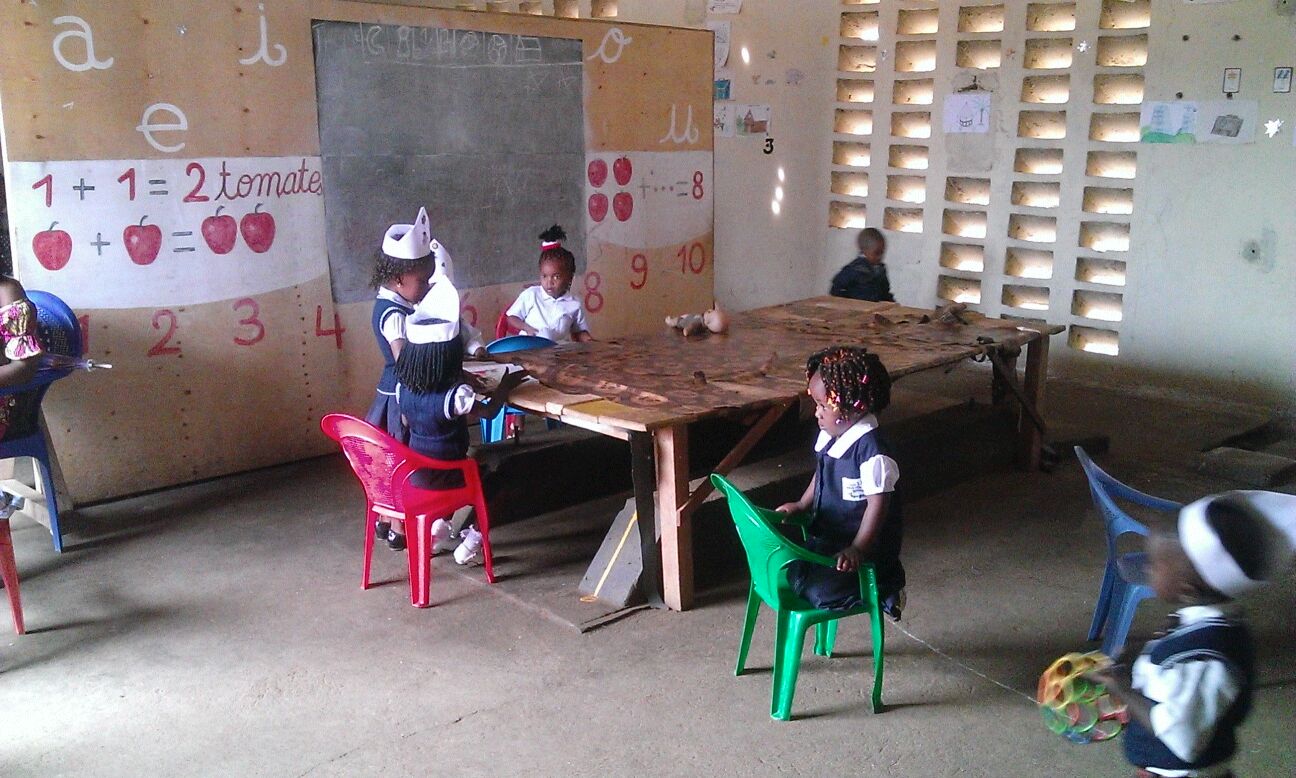
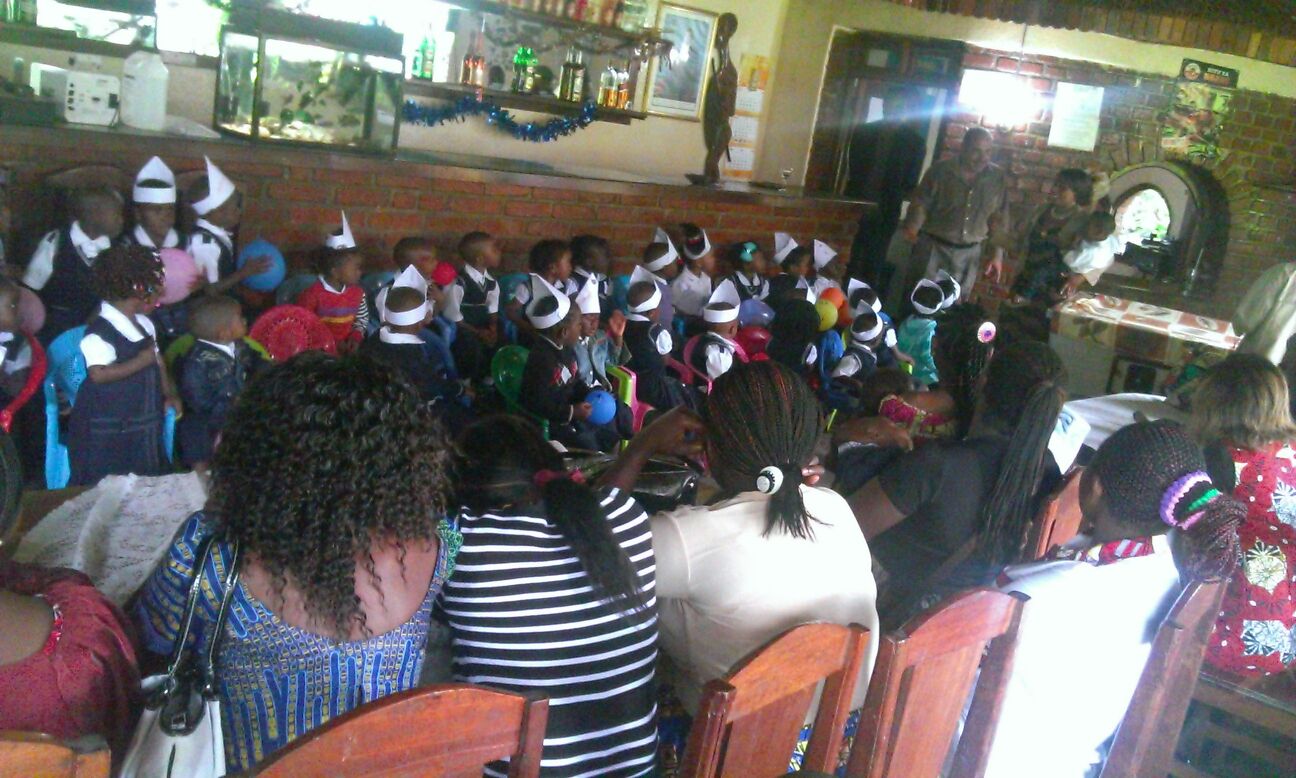
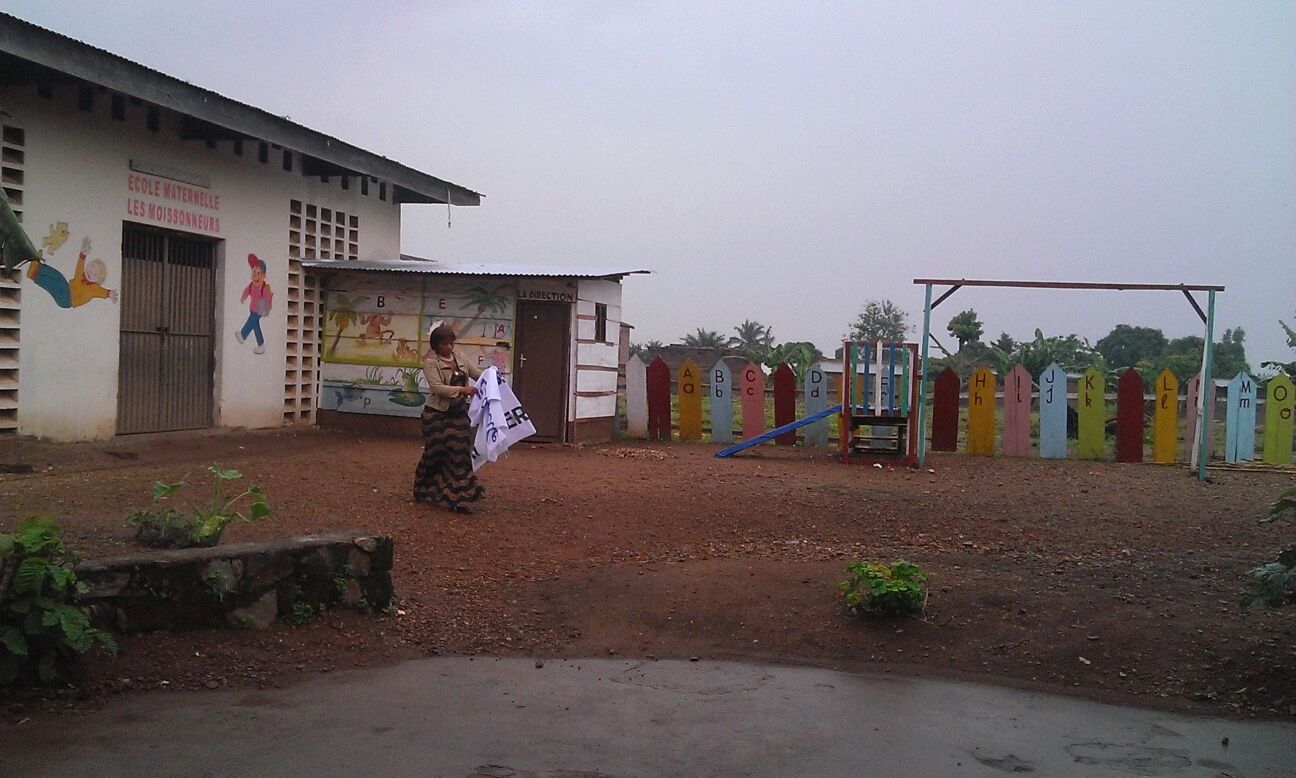
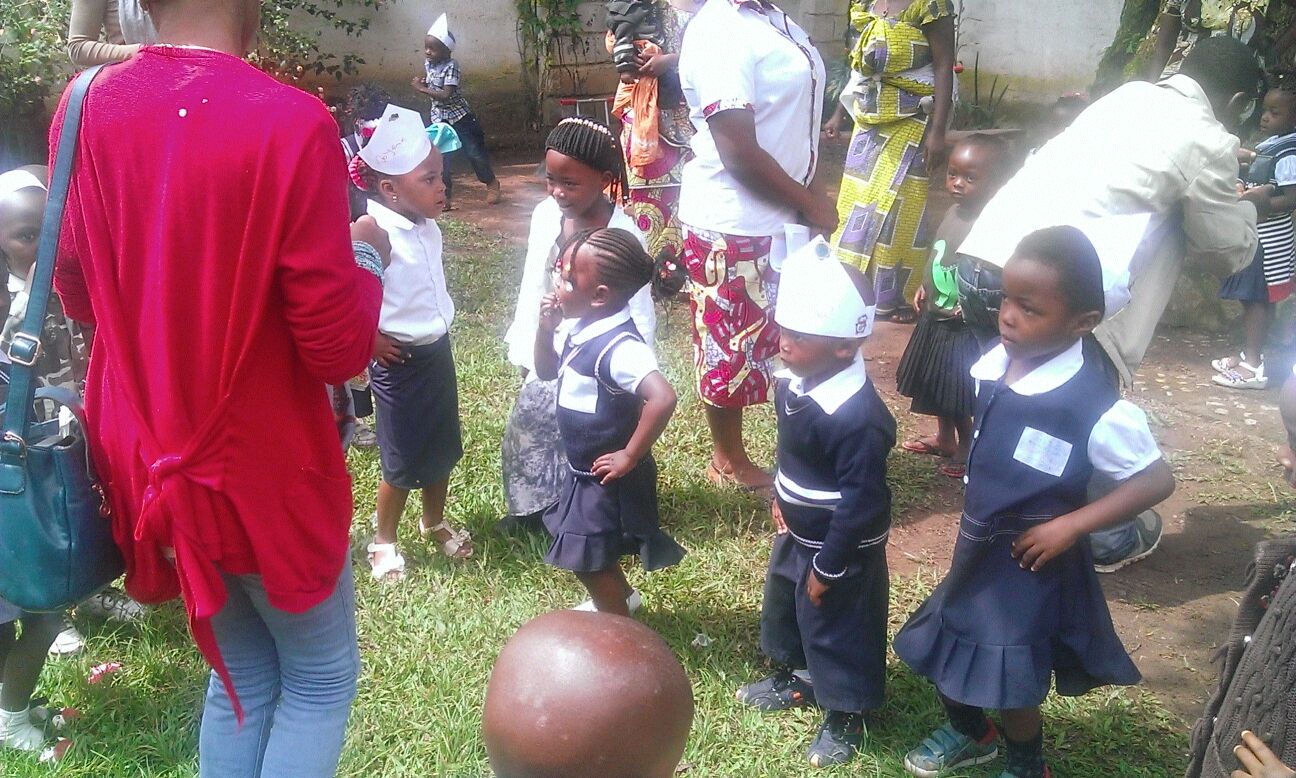
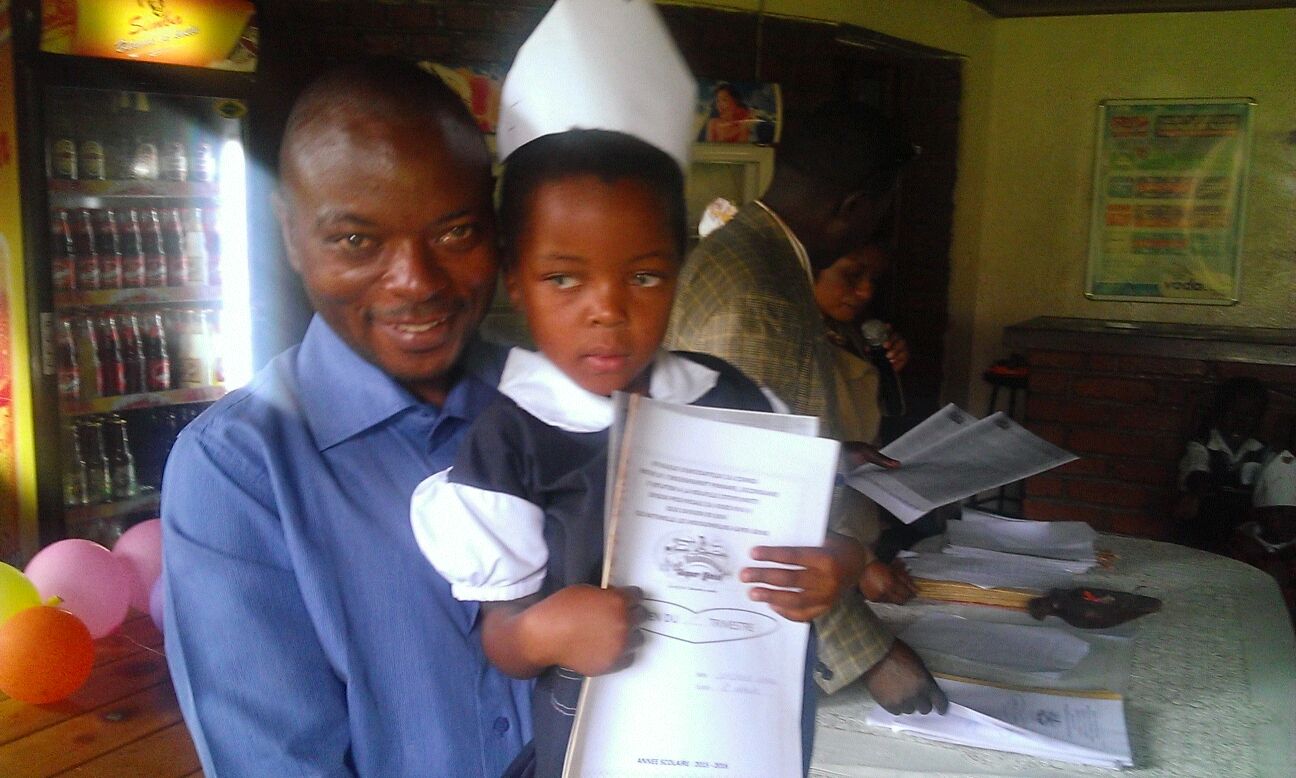
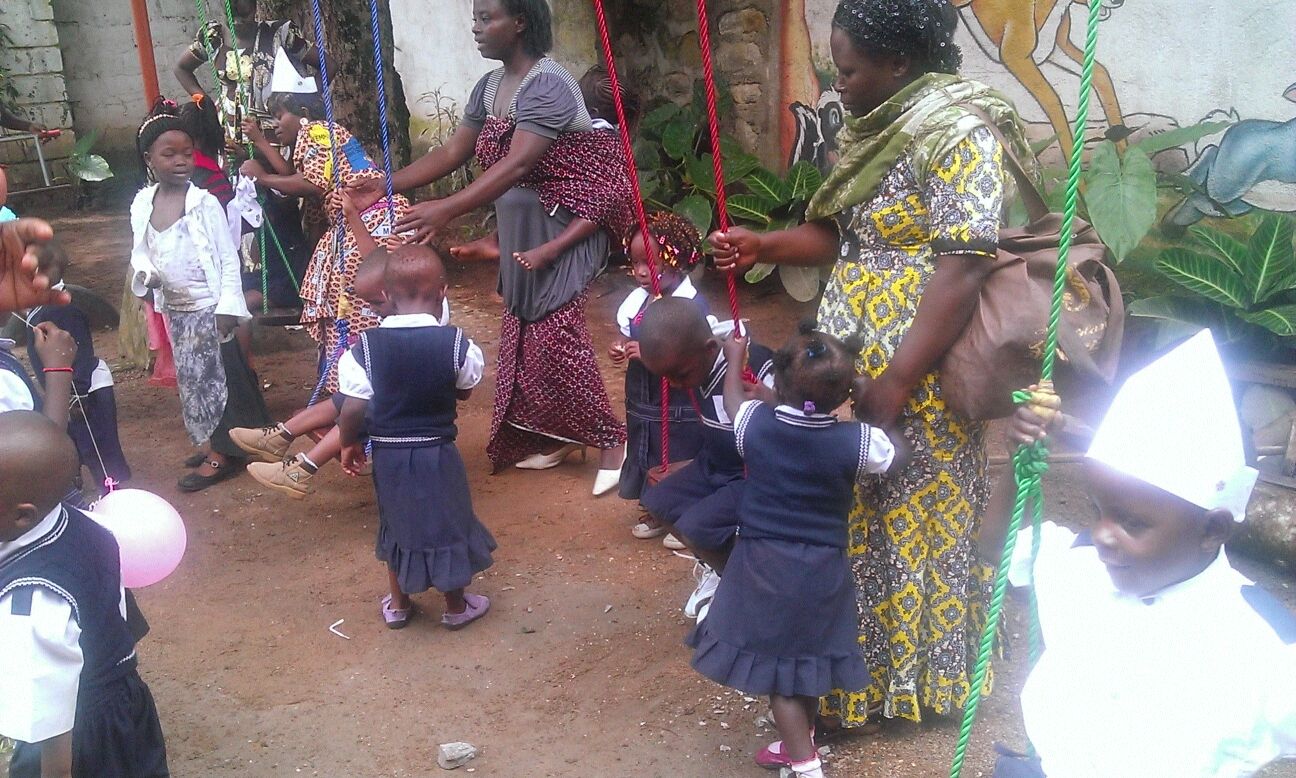
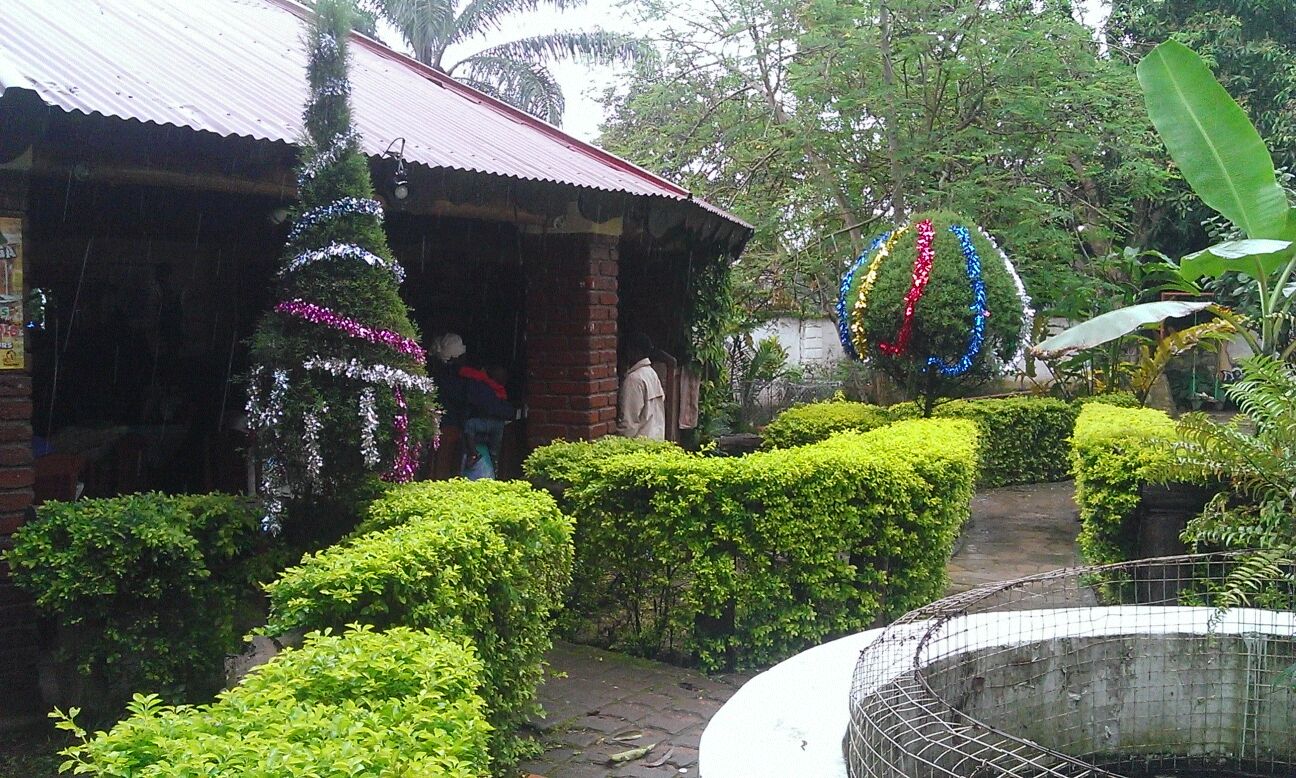
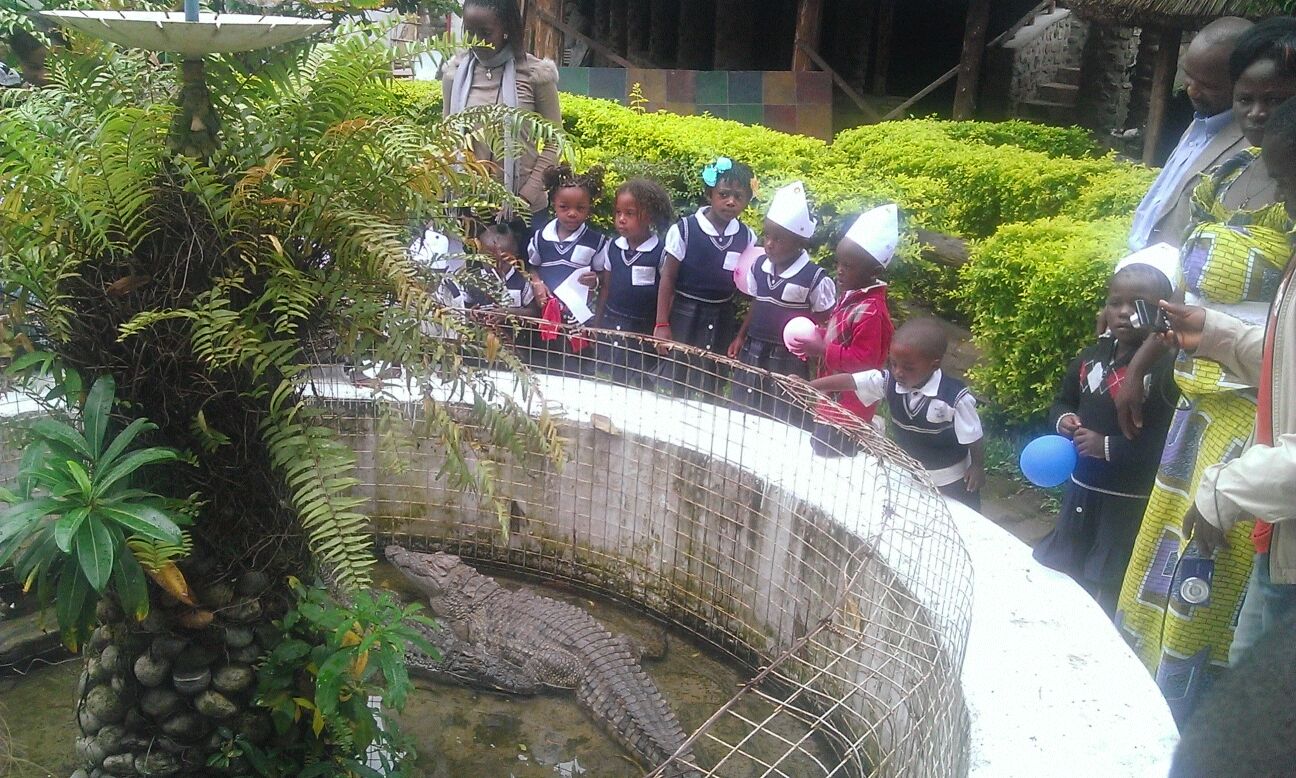
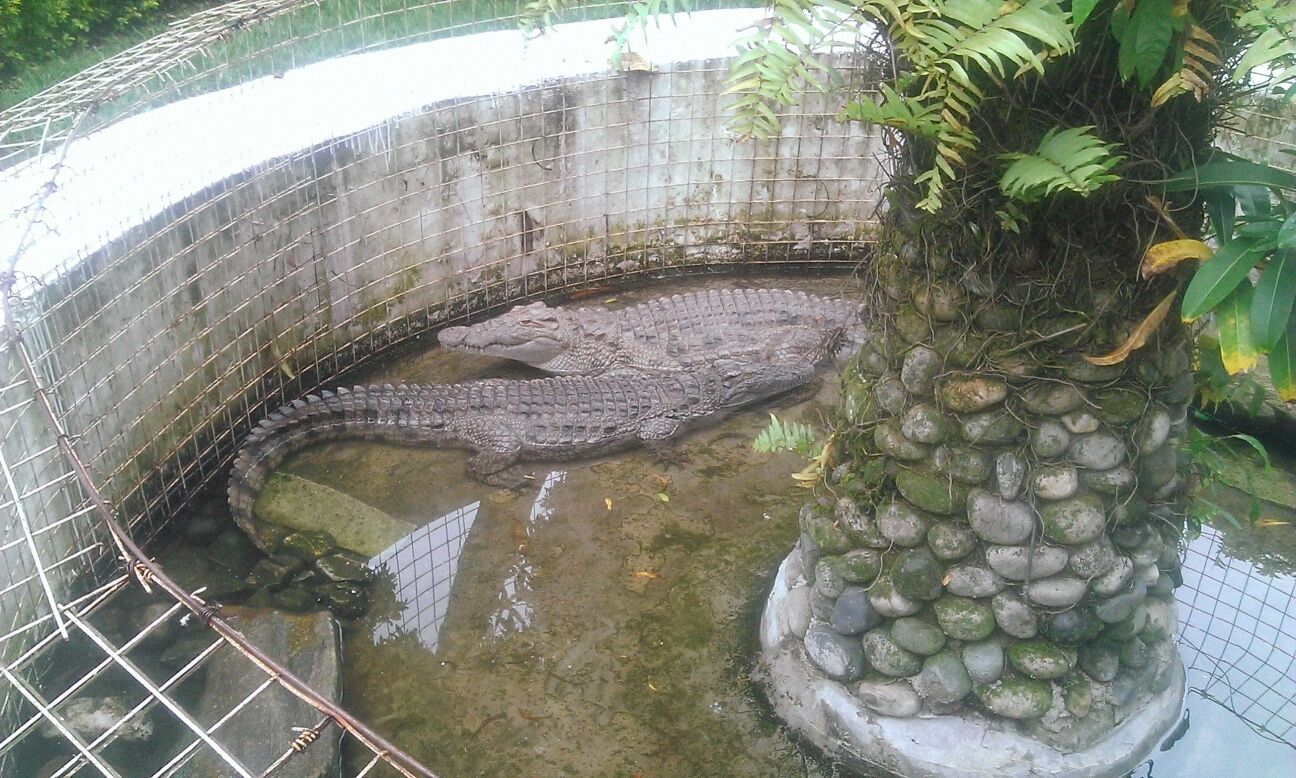
James Kataliko has forwarded the following pictures from the Ecole Maternelle les Moissonneurs in Beni. It was the end of the term and time for a celebration, parent open house and school trip. I have no idea where the crocodiles are kept! James has been a big supporter of this school with some of our funding steered this way. Despite the atrocities occurring immediately around them, life must go on.
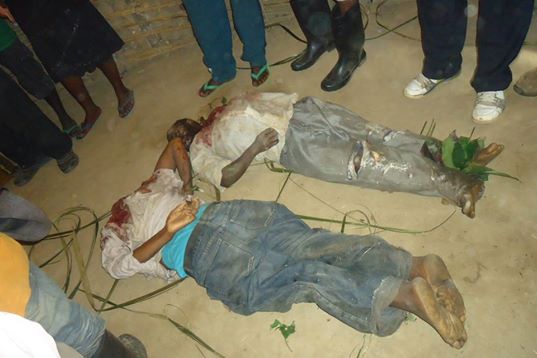
These pictures were forwarded with a report that 17 people have been killed in Beni, DRC by Islamic ADF terrorists. I have no more words at this time.
UPDATE: A Catholic news agency, Agenzia Fides, has provided an report on the massacres. Otherwise, media has been ignoring this story:
Kinshasa (Agenzia Fides) – Christmas Eve marked by blood in three places in the territory of Beni, in North Kivu, in the east of the Democratic Republic of Congo. According to news sent to Agenzia Fides, in the early morning of December 24 the residents of Vemba-Todo/Mavivi, Mukoko/Oïcha, and Mayangos/Assets were attacked by guerrillas of the ADF-Nalu, a group of Ugandan origin, and killed at least 20 civilians.
It is the first time that three places are affected at the same time, point out local commentators, who also denounced the practice of the dismembering of the bodies of victims to sow terror among the population. The ADF-Nalu has acquired in recent years the characterization of a jihadist movement, but according to residents in the region only the last of several armed groups active in the area, supported by local powers and non-Africans, who wreak havoc in order to take advantage of the huge local natural resources.
According to information sent to Agenzia Fides, the massacres were perpetrated between 16 and 22 December. Most of those killed were hostages kidnapped before.
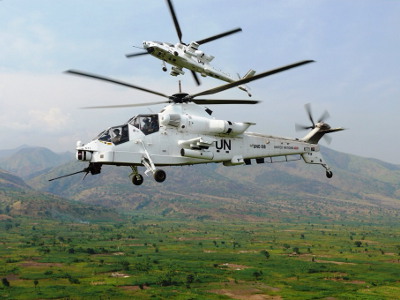
The FARDC (Congo Army) had taken responsibility for dealing with the Islamic ADF, but with civilian causalities growing and the population in fear, little progress was evident. After seven civilians were hacked to death yesterday by machete in north east North Kivu near Semuliki Park, Monusco (UN) stepped in with helicopter gunships and aggressively attached ADF positions. 12 rebels and 4 FARDC soldiers have been killed with some reporting over 30 killed amid fierce fighting. A Monusco soldier from Malawi was reported among the dead. UN Secretary General Ban Ki-moon has condemned the ADF attacks.
It would be interesting to be a fly on the wall to understand the dynamics between the FARDC and Monusco as there has been considerable tension between them. Monusco has reorganized themselves to be a stronger and more intentional fighting force from African countries whereas they had been heavily comprised of soldiers from Muslim Asian countries and totally ineffective. I suspect that Monusco was (finally) actually itching for a fight after watching the ongoing civilian atrocities. Hopefully they will keep up the pressure and soon eliminate the ADF altogether.
South African Rooivalk Attack Helicopters Deployed in North Kivu
The Congo Research Group (CRG) is an independent NYC based non-profit research project dedicated to understanding the violence that affects millions of Congolese. They have been studying and documenting the nature of the conflict in the Kivu provinces. They have recently published a new essay on the topic that provides some significant insights.
The CRG notes that there are now 70 active armed groups in the region, and increase from less than 20 groups in 2008. There has been an obvious trend towards fragmentation of groups, with most of them comprising less than 200 men. The largest group remains the FDLR, who are former members of the Rwandan army that helped organize the genocide in 1994. While the FDLR may still be the largest group despite FARDC (Congo army) efforts to destroy them, Rwandan influence within Congo is believed to be at its lowest since the genocide. The Islamic ADF is said to have given up on controlling Uganda (their original goal) and now resort to banditry in the Beni area. A lack of economic improvement has reduced the ability to entice local leaders of all groups to invest in stability rather than conflict. All that’s left has been a military strategy which is lacking in diplomatic or peace-building efforts.
The above map indicates zones of influence, not control. While useful then to identify areas to avoid, by indicating zones of influence the map would tend to exaggerate the extent of control by these armed groups. It is also not meant to imply that armed groups are not operating further north or elsewhere in Congo.
Jason Stearns is the director of the CRG. He has been working on conflict dynamics in Central Africa since 2001, when he spent a year working for a local human rights group in Bukavu. He is author of Dancing in the Glory of Monsters: The Collapse of the Congo and the Great War of Africa, a book I highly recommend if you are interested in understanding the history of the Congo conflict.
Medair is a Switzerland based humanitarian organization that operates in some of the remotest locations in the world. This short and excellent video documents some of their work in North Kivu province and the delivery of a solar powered fridge needed to store medicines in a remote village.




 Bens in Congo